
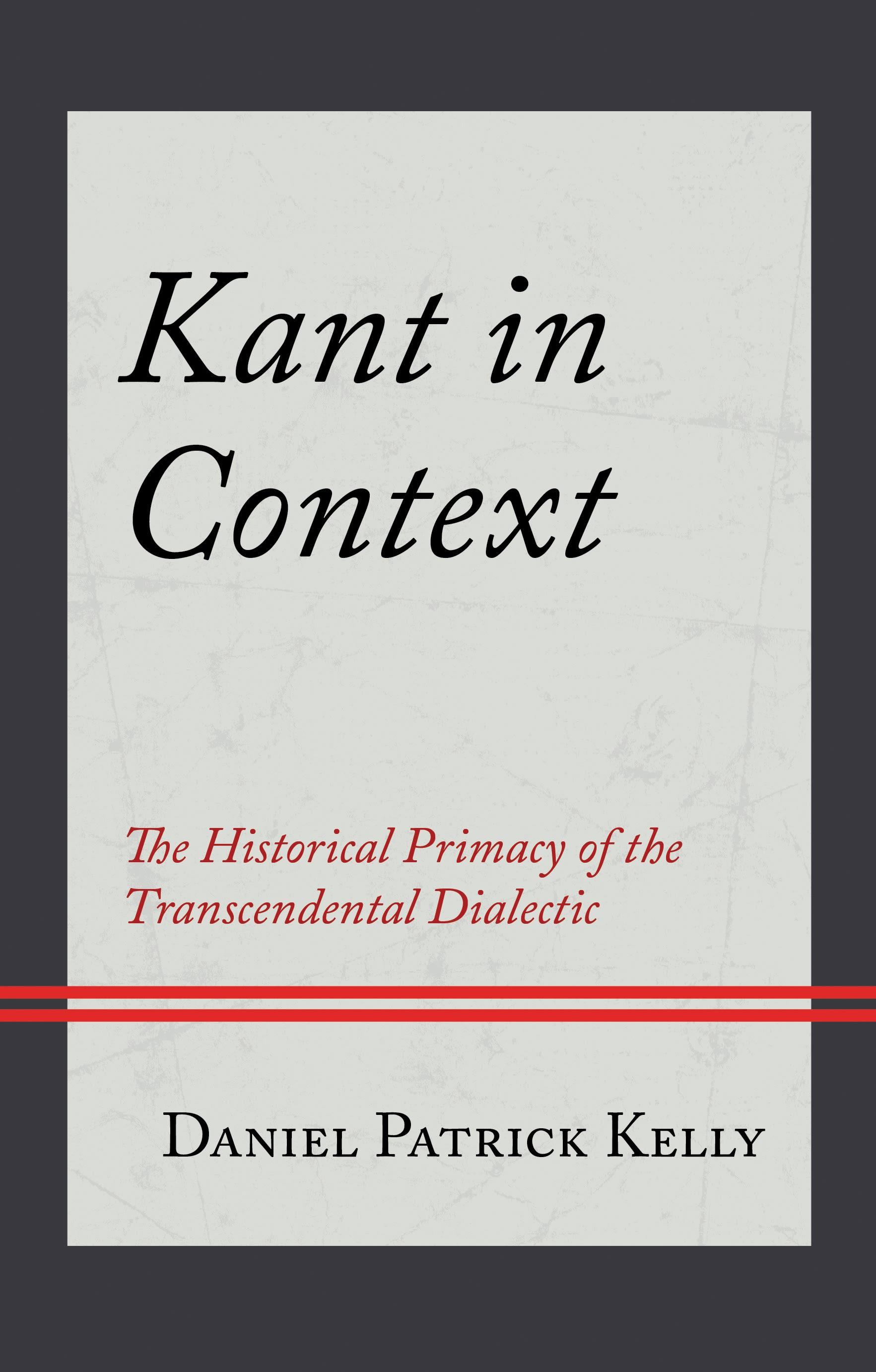
Kant in Context: The Historical Primacy of the Transcendental Dialectic examines the introduction of Kant’s critical philosophy through the lens of historical contextualization. Daniel Patrick Kelly argues that Kant’s seismic Copernican epistemic turn must be adequately positioned and understood within the German philosophical landscape that developed in Spinoza’s wake. This necessary historical analysis illuminates the development and comparative strength of Kant’s emergent transcendental idealism. However, in order to render the introduction of Kant’s critical system sufficient to this historical task, this book heuristically organizes the contents of the Critique of Pure Reason to highlight the work’s meta-philosophical historical conclusions. In this revised take on Kant’s Critique, Kelly argues that the "Transcendental Aesthetic" and subsequent "Transcendental Dialectic" emerge as foundational in understanding Kant’s Critique as a profound historical-methodological development, as they justify and ground the call for his new and supporting science of cognition, placing the "Transcendental Analytic" as inherently secondary in this heuristic reading of the Critique. The author’s overarching contention is that Kant’s identification of the dialectical limitations of metaphysical reasoning provides a more solid justification for Kant’s transcendental idealism than that of the novel postulates of the "Analytic."
Betaal eenvoudig met kaart, Klarna, Apple Pay of Google Pay. Niet tevreden? Je hebt altijd 14 dagen bedenktijd. Lees meer in onze voorwaarden. Heb je vragen, mail ons dan via hello@memmo.org.
Memmo maakt studeren makkelijker – waar je ook bent ter wereld. Wij brengen je cursusboeken en slimme studietools samen op één plek: samenvattingen, quizzen, podcasts en flashcards. En Ted, je studievriend die antwoord geeft op alles wat je je afvraagt. Meer dan 50.000 studenten studeren hier al – gebouwd om je sneller te laten leren en minder stress te geven.