
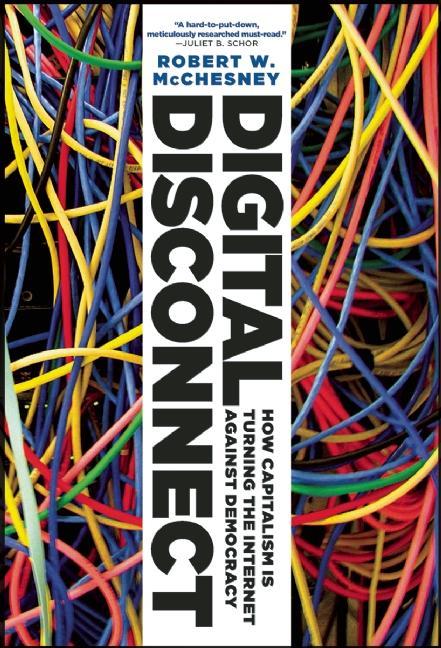
Celebrants and skeptics alike have produced valuable analyses of the Internet's effect on us and our world, oscillating between utopian bliss and dystopian hell. But according to Robert W. McChesney, arguments on both sides fail to address the relationship between economic power and the digital world.
McChesney's award-winning Rich Media, Poor Democracy skewered the assumption that a society drenched in commercial information is a democratic one. In Digital Disconnect McChesney returns to this provocative thesis in light of the advances of the digital age, incorporating capitalism into the heart of his analysis. He argues that the sharp decline in the enforcement of antitrust violations, the increase in patents on digital technology and proprietary systems, and other policies and massive indirect subsidies have made the Internet a place of numbing commercialism. A small handful of monopolies now dominate the political economy, from Google, which garners an astonishing 97 percent share of the mobile search market, to Microsoft, whose operating system is used by over 90 percent of the world's computers. This capitalistic colonization of the Internet has spurred the collapse of credible journalism, and made the Internet an unparalleled apparatus for government and corporate surveillance, and a disturbingly anti-democratic force.
In Digital Disconnect Robert McChesney offers a groundbreaking analysis and critique of the Internet, urging us to reclaim the democratizing potential of the digital revolution while we still can.
McChesney's award-winning Rich Media, Poor Democracy skewered the assumption that a society drenched in commercial information is a democratic one. In Digital Disconnect McChesney returns to this provocative thesis in light of the advances of the digital age, incorporating capitalism into the heart of his analysis. He argues that the sharp decline in the enforcement of antitrust violations, the increase in patents on digital technology and proprietary systems, and other policies and massive indirect subsidies have made the Internet a place of numbing commercialism. A small handful of monopolies now dominate the political economy, from Google, which garners an astonishing 97 percent share of the mobile search market, to Microsoft, whose operating system is used by over 90 percent of the world's computers. This capitalistic colonization of the Internet has spurred the collapse of credible journalism, and made the Internet an unparalleled apparatus for government and corporate surveillance, and a disturbingly anti-democratic force.
In Digital Disconnect Robert McChesney offers a groundbreaking analysis and critique of the Internet, urging us to reclaim the democratizing potential of the digital revolution while we still can.
Betaal eenvoudig met kaart, Klarna, Apple Pay of Google Pay. Niet tevreden? Je hebt altijd 14 dagen bedenktijd. Lees meer in onze voorwaarden. Heb je vragen, mail ons dan via hello@memmo.org.
Memmo maakt studeren makkelijker – waar je ook bent ter wereld. Wij brengen je cursusboeken en slimme studietools samen op één plek: samenvattingen, quizzen, podcasts en flashcards. En Ted, je studievriend die antwoord geeft op alles wat je je afvraagt. Meer dan 50.000 studenten studeren hier al – gebouwd om je sneller te laten leren en minder stress te geven.
Misschien vind je dit ook leuk
Koop het boek0