
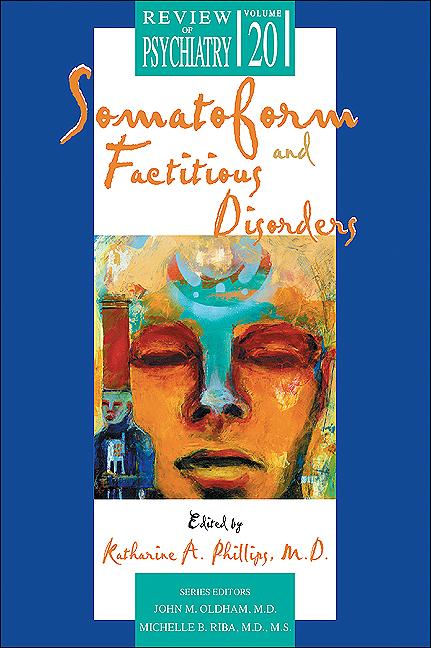
Beset by contradictions, somatoform and factitious disorders have an unusually long, rich, and colorful historical and clinical tradition. Yet, some of them have received only limited empirical investigation.
This book continues that rich tradition by offering a broad and scholarly synthesis of the current knowledge -- and controversies -- about somatoform and factitious disorders. Here you'll find up-to-date, clinically focused overviews of these intriguing and often difficult-to-treat disorders.
Recognized experts present the latest findings along with insightful recommendations and illustrative case studies on Somatization disorder -- The evolution and problems of diagnostic criteria (e.g., its focus on symptom counting), epidemiology, clinical features, etiologic considerations, differential diagnosis (e.g., contrasted with depressive and anxiety disorders), evaluation (use of questionnaires), and treatment considerations (psychotherapy, psychotropic medications). Hypochondriasis -- History, clinical features, theoretical models (psychodynamic, cognitive-behavioral, and physiologic), research studies, and practical techniques for treatment (from pharmacotherapy to cognitive behavioral therapy to alternative treatments such as relaxation therapy). Body dysmorphic disorder -- History and prevalence, clinical features, treatment (including surgery and nonpsychiatric medical treatment), etiology and pathophysiology (its relationship to obsessive-compulsive, depressive, and eating disorders), and diagnosis and misdiagnosis. Conversion disorder -- Diagnostic criteria and clinical subtypes, history and definitions, models of symptom generation, functions served by conversion symptoms, associated features, epidemiology, demographic and disease course, comorbidity, differential diagnosis, and treatment (best done in collaboration with an internist, primary care physician, or neurologist). Factitious disorders (widely known as Munchausen syndrome, its most extreme subtype) -- Empirical evidence related to epidemiology and etiology; diagnosis, clinical description, prevalence, and associated costs; limitations of current approaches; the reliability and usefulness of differential diagnoses; comorbidity, etiology, and management.
Both concise and thorough, this extensively annotated volume clarifies the issues surrounding these fascinating disorders and offers practical guidance and recommendations, highlighting the pressing need for further research to improve patient care. As such, it will prove compelling reading for practicing psychiatrists and other physicians in any clinical setting who want to better understand the baffling complexities of these distressing disorders.
Betaal eenvoudig met kaart, Klarna, Apple Pay of Google Pay. Niet tevreden? Je hebt altijd 14 dagen bedenktijd. Lees meer in onze voorwaarden. Heb je vragen, mail ons dan via hello@memmo.org.
Memmo maakt studeren makkelijker – waar je ook bent ter wereld. Wij brengen je cursusboeken en slimme studietools samen op één plek: samenvattingen, quizzen, podcasts en flashcards. En Ted, je studievriend die antwoord geeft op alles wat je je afvraagt. Meer dan 50.000 studenten studeren hier al – gebouwd om je sneller te laten leren en minder stress te geven.