
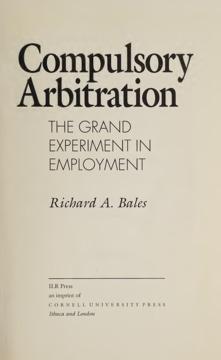
This is the first book on a crucial issue in human resource management. In recent years, employers have begun to require, as a condition of employment, that their nonunion employees agree to arbitrate rather than litigate any employment disputes, including claims of discrimination. As the number of employers considering such a requirement soars, so does the fear that compulsory arbitration may eviscerate the statutory rights of employees.
Richard A. Bales explains that the advantages of arbitration are clear. Much faster and less expensive than litigation, arbitration provides a forum for the many employees who are shut out of the current litigative system by the cost and by the tremendous backlog of cases. On the other hand, employers could use arbitration abusively. Bales views the current situation as an ongoing experiment. As long as the courts continue to enforce agreements that are fundamentally fair to employees, the experiment will continue.
After tracing the history of employment arbitration in the nonunion sector, Bales explains how employment arbitration has actually worked in the securities industry and at Brown & Root, a company with a comprehensive dispute resolution process. He concludes by summarizing the advantages, disadvantages, and policy implications of adopting arbitration as the preeminent method of resolving disputes in the American workforce.
Betaal eenvoudig met kaart, Klarna, Apple Pay of Google Pay. Niet tevreden? Je hebt altijd 14 dagen bedenktijd. Lees meer in onze voorwaarden. Heb je vragen, mail ons dan via hello@memmo.org.
Memmo maakt studeren makkelijker – waar je ook bent ter wereld. Wij brengen je cursusboeken en slimme studietools samen op één plek: samenvattingen, quizzen, podcasts en flashcards. En Ted, je studievriend die antwoord geeft op alles wat je je afvraagt. Meer dan 50.000 studenten studeren hier al – gebouwd om je sneller te laten leren en minder stress te geven.