
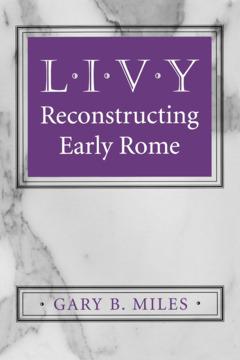
Some critics of the Roman historian Livy (59 B.C.-A.D. 17) have dismissed his work as a compendium of stale narratives and conventional attitudes. Gary B. Miles reveals in Livy's history a creative interplay between traditional stories, contemporary ideological assumptions, and the historian's own perspective at the margins of Roman aristocracy.
Drawing on a range of critical approaches, Miles considers Livy's stance as a historian, the ways in which he reworked his sources, and his interpretation of such historical phenomena as recurrence, continuity, and change. Miles focuses on the foundation stories with which Livy begins his account, detecting in Livy's rendition certain original conceptions of historical time including the suggestion that Roman identity and greatness might be preserved indefinitely through successive reenactments of a historical cycle.
Miles pays particular attention to two stories—those of the abduction of the Sabine women and of Romulus and Remus, showing how Livy's versions of these traditional narratives—far from leading to a simplistic moral—address unresolved political issues of his day. According to Miles, Livy shows an unusually tenacious willingness to confront dilemmas in historiography and Roman ideology which were commonly ignored or suppressed by both his predecessors and his contemporaries.
Betaal eenvoudig met kaart, Klarna, Apple Pay of Google Pay. Niet tevreden? Je hebt altijd 14 dagen bedenktijd. Lees meer in onze voorwaarden. Heb je vragen, mail ons dan via hello@memmo.org.
Memmo maakt studeren makkelijker – waar je ook bent ter wereld. Wij brengen je cursusboeken en slimme studietools samen op één plek: samenvattingen, quizzen, podcasts en flashcards. En Ted, je studievriend die antwoord geeft op alles wat je je afvraagt. Meer dan 50.000 studenten studeren hier al – gebouwd om je sneller te laten leren en minder stress te geven.