
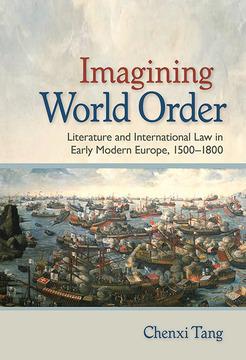
In early modern Europe, international law emerged as a means of governing relations between rapidly consolidating sovereign states, purporting to establish a normative order for the perilous international world. However, it was intrinsically fragile and uncertain, for sovereign states had no acknowledged common authority that would create, change, apply, and enforce legal norms. In Imagining World Order, Chenxi Tang shows that international world order was as much a literary as a legal matter. To begin with, the poetic imagination contributed to the making of international law. As the discourse of international law coalesced, literary works from romances and tragedies to novels responded to its unfulfilled ambitions and inexorable failures, occasionally affirming it, often contesting it, always uncovering its problems and rehearsing imaginary solutions.
Tang highlights the various modes in which literary texts—some highly canonical (Camões, Shakespeare, Corneille, Lohenstein, and Defoe, among many others), some largely forgotten yet worth rediscovering—engaged with legal thinking in the period from the sixteenth to the eighteenth century. In tracing such engagements, he offers a dual history of international law and European literature. As legal history, the book approaches the development of international law in this period—its so-called classical age—in terms of literary imagination. As literary history, Tang recounts how literature confronted the question of international world order and how, in the process, a set of literary forms common to major European languages (epic, tragedy, romance, novel) evolved.
Betaal eenvoudig met kaart, Klarna, Apple Pay of Google Pay. Niet tevreden? Je hebt altijd 14 dagen bedenktijd. Lees meer in onze voorwaarden. Heb je vragen, mail ons dan via hello@memmo.org.
Memmo maakt studeren makkelijker – waar je ook bent ter wereld. Wij brengen je cursusboeken en slimme studietools samen op één plek: samenvattingen, quizzen, podcasts en flashcards. En Ted, je studievriend die antwoord geeft op alles wat je je afvraagt. Meer dan 50.000 studenten studeren hier al – gebouwd om je sneller te laten leren en minder stress te geven.