
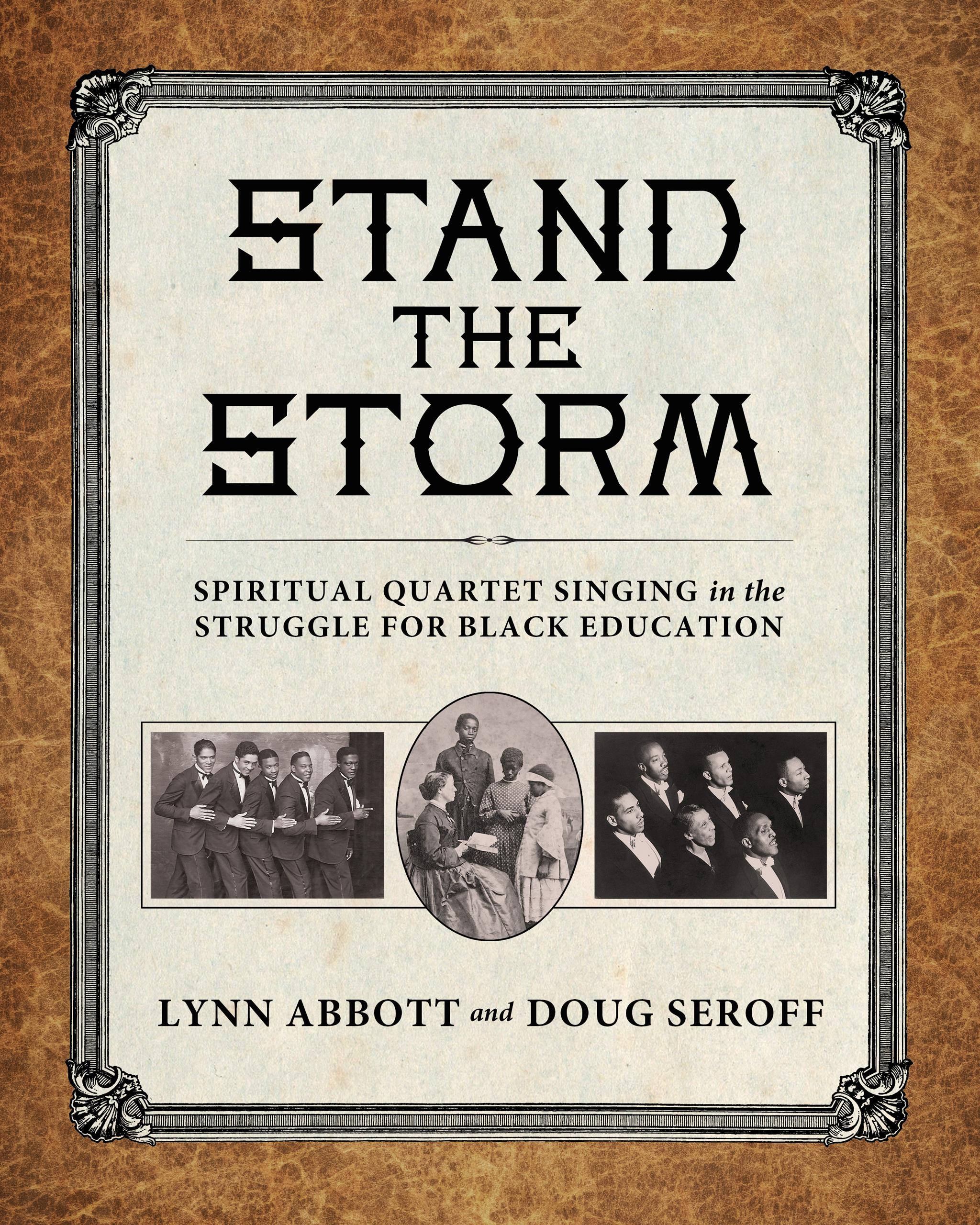
Black education in the South was the great social program of the post–Civil War era. Desperately strapped for operating capital, the first freedmen’s schools resorted to a bold fundraising experiment. Student troupes were sent to the North singing Negro spirituals, the sacred songs of slavery, in order to generate goodwill and entice financial support. The Fisk University Jubilee Singers set this strategy in motion in 1871; in the wake of their success, it was adopted by HBCUs throughout the Southland. Intrepid student singers introduced the outside world to the Negro spirituals, the “genuine jewels” they brought from their bondage, and “sang up” school buildings in the process. Negro spiritual singing was a revelation for the northern public; it was their initial exposure to an emergent, distinctly American kind of creative energy. Male quartets became the standard-bearers of this venerable Black music tradition.
In Stand the Storm: Spiritual Quartet Singing in the Struggle for Black Education, award-winning authors Lynn Abbott and Doug Seroff dive into the history of three generations of fundraising quartets from seven representative schools: Fisk, Hampton, Tuskegee, Penn, Calhoun, Utica, and Piney Woods. They acknowledge the heroic founders of the schools and restore the names of forgotten singers to the historical record. They reevaluate the industrial education model that guided these schools. Finally, they plot the evolution of Negro spiritual singing after Emancipation by scrutinizing early published song collections and comparing them with songbooks and recordings from subsequent eras.
In Stand the Storm: Spiritual Quartet Singing in the Struggle for Black Education, award-winning authors Lynn Abbott and Doug Seroff dive into the history of three generations of fundraising quartets from seven representative schools: Fisk, Hampton, Tuskegee, Penn, Calhoun, Utica, and Piney Woods. They acknowledge the heroic founders of the schools and restore the names of forgotten singers to the historical record. They reevaluate the industrial education model that guided these schools. Finally, they plot the evolution of Negro spiritual singing after Emancipation by scrutinizing early published song collections and comparing them with songbooks and recordings from subsequent eras.
Betaal eenvoudig met kaart, Klarna, Apple Pay of Google Pay. Niet tevreden? Je hebt altijd 14 dagen bedenktijd. Lees meer in onze voorwaarden. Heb je vragen, mail ons dan via hello@memmo.org.
Memmo maakt studeren makkelijker – waar je ook bent ter wereld. Wij brengen je cursusboeken en slimme studietools samen op één plek: samenvattingen, quizzen, podcasts en flashcards. En Ted, je studievriend die antwoord geeft op alles wat je je afvraagt. Meer dan 50.000 studenten studeren hier al – gebouwd om je sneller te laten leren en minder stress te geven.
Misschien vind je dit ook leuk
Koop het boek0