
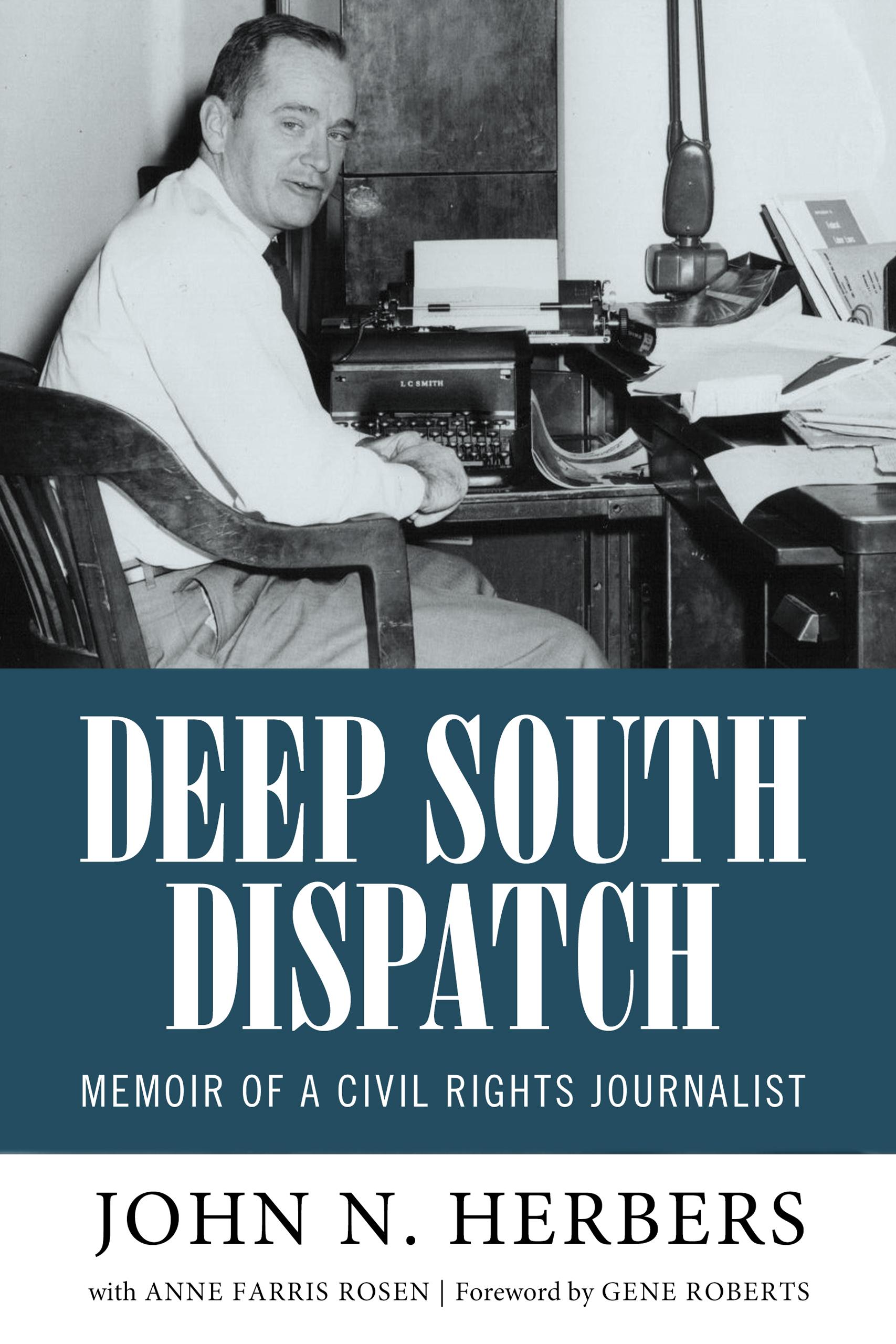
Former New York Times correspondent John N. Herbers (1923-2017), who covered the civil rights movement for more than a decade, has produced Deep South Dispatch: Memoir of a Civil Rights Journalist, a compelling story of national and historical significance. Born in the South during a time of entrenched racial segregation, Herbers witnessed a succession of landmark civil rights uprisings that rocked the country, the world, and his own conscience. Herbers's retrospective is a timely and critical illumination on America's current racial dilemmas and ongoing quest for justice.
Herbers's reporting began in 1951, when he covered the brutal execution of Willie McGee, a black man convicted for the rape of a white housewife, and the 1955 trial for the murder of Emmett Till, a black teenager killed for allegedly whistling at a white woman. With immediacy and first-hand detail, Herbers describes the assassination of John F. Kennedy; the death of four black girls in the Birmingham, Alabama, church bombing; extensive travels and interviews with Martin Luther King Jr.; Ku Klux Klan cross-burning rallies and private meetings; the Freedom Summer murders in Philadelphia, Mississippi; and marches and riots in St. Augustine, Florida, and Selma, Alabama, that led to passage of national civil rights legislation.
This account is also a personal journey as Herbers witnessed the movement with the conflicted eyes of a man dedicated to his southern heritage but who also rejected the prescribed laws and mores of a prejudiced society. His story provides a complex understanding of how the southern status quo, in which the white establishment benefited at the expense of African Americans, was transformed by a national outcry for justice.
Herbers's reporting began in 1951, when he covered the brutal execution of Willie McGee, a black man convicted for the rape of a white housewife, and the 1955 trial for the murder of Emmett Till, a black teenager killed for allegedly whistling at a white woman. With immediacy and first-hand detail, Herbers describes the assassination of John F. Kennedy; the death of four black girls in the Birmingham, Alabama, church bombing; extensive travels and interviews with Martin Luther King Jr.; Ku Klux Klan cross-burning rallies and private meetings; the Freedom Summer murders in Philadelphia, Mississippi; and marches and riots in St. Augustine, Florida, and Selma, Alabama, that led to passage of national civil rights legislation.
This account is also a personal journey as Herbers witnessed the movement with the conflicted eyes of a man dedicated to his southern heritage but who also rejected the prescribed laws and mores of a prejudiced society. His story provides a complex understanding of how the southern status quo, in which the white establishment benefited at the expense of African Americans, was transformed by a national outcry for justice.
Betaal eenvoudig met kaart, Klarna, Apple Pay of Google Pay. Niet tevreden? Je hebt altijd 14 dagen bedenktijd. Lees meer in onze voorwaarden. Heb je vragen, mail ons dan via hello@memmo.org.
Memmo maakt studeren makkelijker – waar je ook bent ter wereld. Wij brengen je cursusboeken en slimme studietools samen op één plek: samenvattingen, quizzen, podcasts en flashcards. En Ted, je studievriend die antwoord geeft op alles wat je je afvraagt. Meer dan 50.000 studenten studeren hier al – gebouwd om je sneller te laten leren en minder stress te geven.
Misschien vind je dit ook leuk
Koop het boek0