
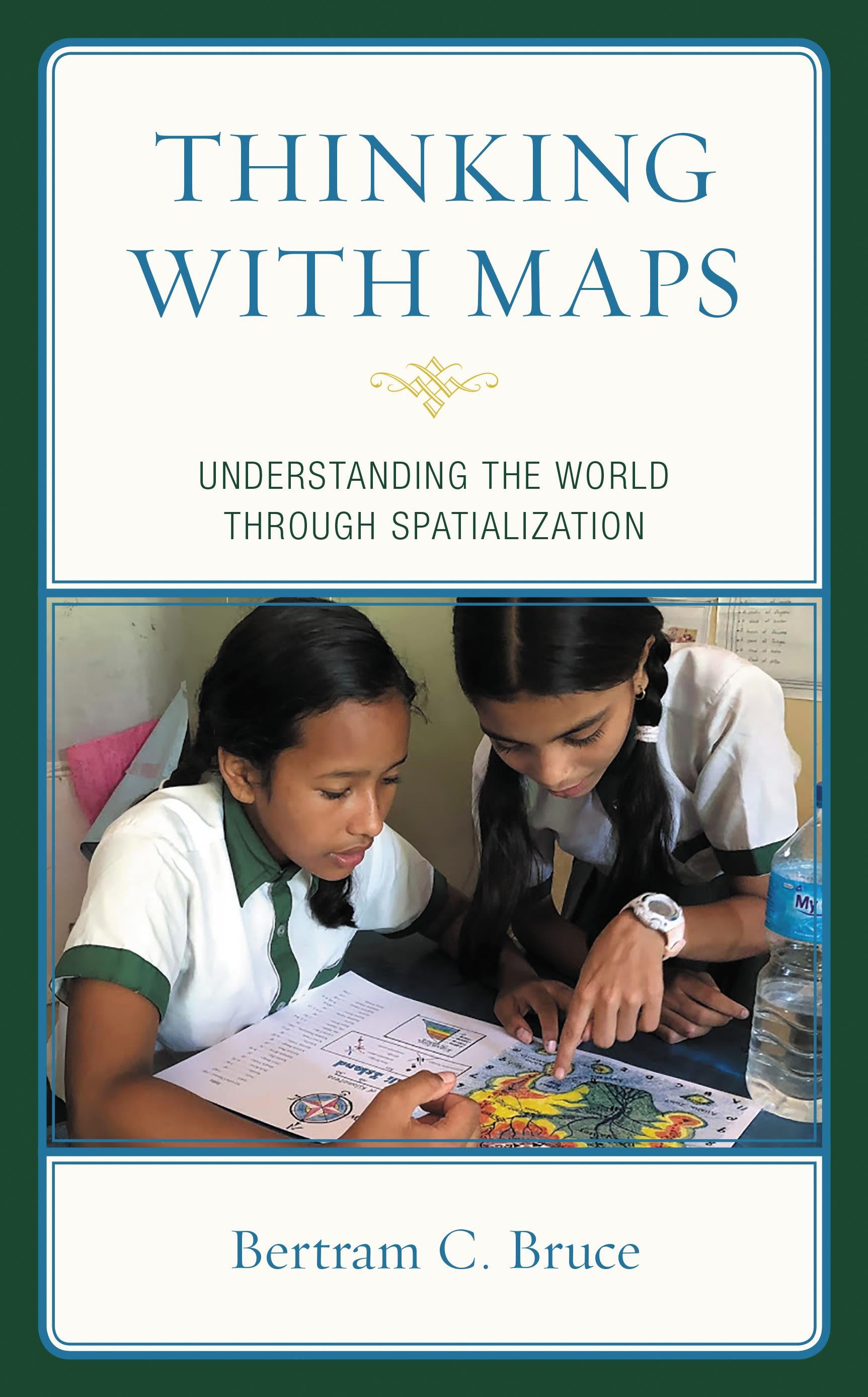
A 2022 Choice Reviews Outstanding Academic Title
Spatial reasoning, which promises connection across wide areas, is itself ironically often not connected to other areas of knowledge. Thinking with Maps: Understanding the World through Spatialization addresses this problem, developing its argument through historical analysis and cross-disciplinary examples involving maps. The idea of maps here includes traditional cartographic representations of physical environments, but more broadly encompasses the wide variety of ways that visualizations are used across all disciplines to enable understanding, to generate new knowledge, and to effect change.
The idea of thinking with maps is also used broadly. Maps become, not simply one among many items to learn about, but indispensable tools for thinking across every field of inquiry, in a way similar to that of textual and mathematical language. Effective use of maps becomes a way to make knowledge, much as writing or mathematical exploration not only displays ideas, but also creates them. The book shows that maps for thinking are not just a means to improve geographic knowledge, as valuable as that may be. Instead, they provide mechanisms for rejuvenating our engagement with the world, helping us to become more capable of facing our global challenges.
This book has a broader aim: It is fundamentally about general principles of how we learn and know. It calls for a renewed focus on democratic education in which both the means and ends are democratic. Education, just as the political realm, should follow Dewey’s dictum that “democratic ends need democratic methods for their realization.” Maps and mapping are invaluable in that endeavor.
Spatial reasoning, which promises connection across wide areas, is itself ironically often not connected to other areas of knowledge. Thinking with Maps: Understanding the World through Spatialization addresses this problem, developing its argument through historical analysis and cross-disciplinary examples involving maps. The idea of maps here includes traditional cartographic representations of physical environments, but more broadly encompasses the wide variety of ways that visualizations are used across all disciplines to enable understanding, to generate new knowledge, and to effect change.
The idea of thinking with maps is also used broadly. Maps become, not simply one among many items to learn about, but indispensable tools for thinking across every field of inquiry, in a way similar to that of textual and mathematical language. Effective use of maps becomes a way to make knowledge, much as writing or mathematical exploration not only displays ideas, but also creates them. The book shows that maps for thinking are not just a means to improve geographic knowledge, as valuable as that may be. Instead, they provide mechanisms for rejuvenating our engagement with the world, helping us to become more capable of facing our global challenges.
This book has a broader aim: It is fundamentally about general principles of how we learn and know. It calls for a renewed focus on democratic education in which both the means and ends are democratic. Education, just as the political realm, should follow Dewey’s dictum that “democratic ends need democratic methods for their realization.” Maps and mapping are invaluable in that endeavor.
Betaal eenvoudig met kaart, Klarna, Apple Pay of Google Pay. Niet tevreden? Je hebt altijd 14 dagen bedenktijd. Lees meer in onze voorwaarden. Heb je vragen, mail ons dan via hello@memmo.org.
Memmo maakt studeren makkelijker – waar je ook bent ter wereld. Wij brengen je cursusboeken en slimme studietools samen op één plek: samenvattingen, quizzen, podcasts en flashcards. En Ted, je studievriend die antwoord geeft op alles wat je je afvraagt. Meer dan 50.000 studenten studeren hier al – gebouwd om je sneller te laten leren en minder stress te geven.