
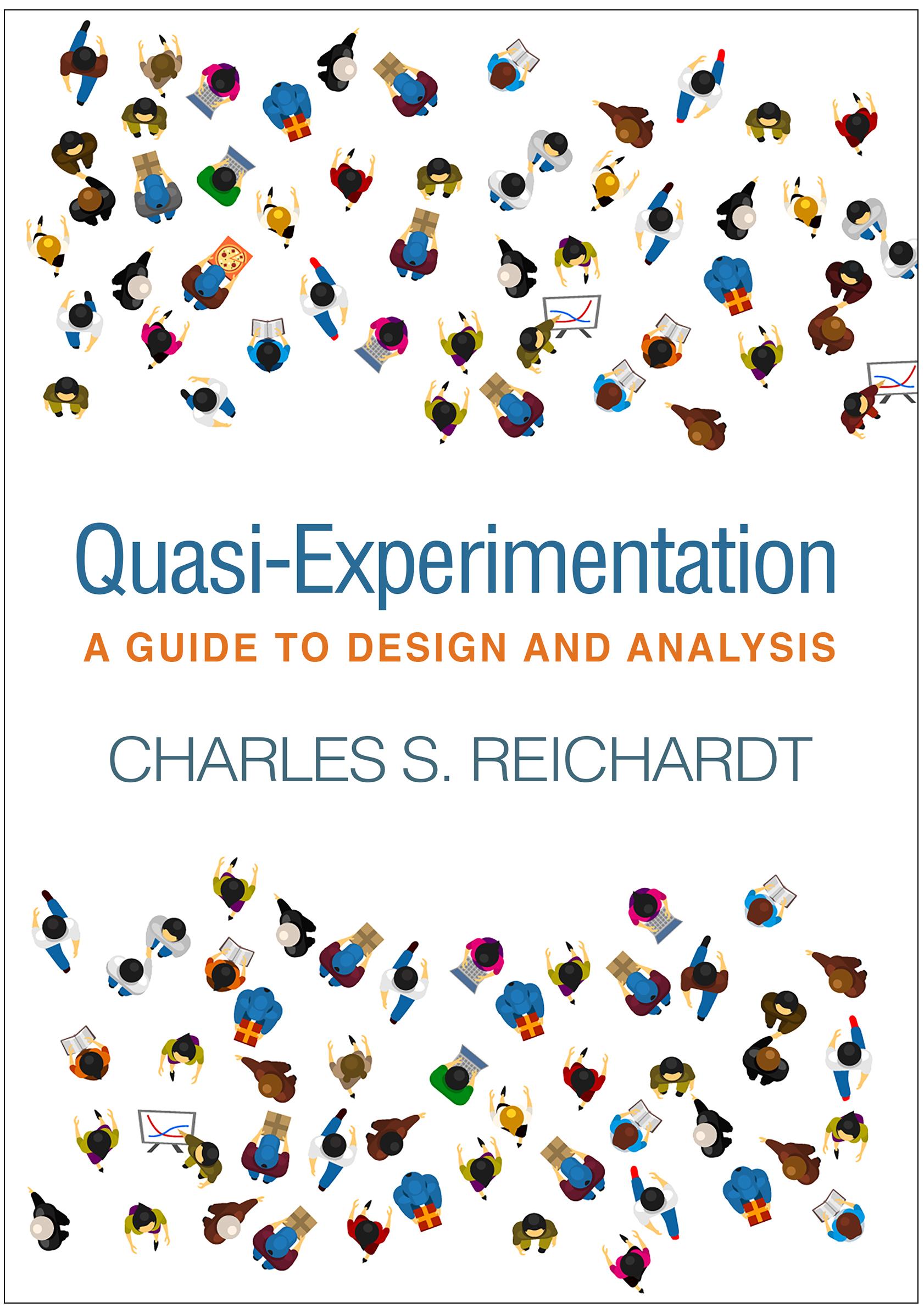
Featuring engaging examples from diverse disciplines, this book explains how to use modern approaches to quasi-experimentation to derive credible estimates of treatment effects under the demanding constraints of field settings. Foremost expert Charles S. Reichardt provides an in-depth examination of the design and statistical analysis of pretest–posttest, nonequivalent groups, regression discontinuity, and interrupted time-series designs. He details their relative strengths and weaknesses and offers practical advice about their use. Comparing quasi-experiments to randomized experiments, Reichardt discusses when and why the former might be a better choice than the latter in the face of the contingencies that are likely to arise in practice. Modern methods for elaborating a research design to remove bias from estimates of treatment effects are described, as are tactics for dealing with missing data and noncompliance with treatment assignment. Throughout, mathematical equations are translated into words to enhance accessibility. Adding to its discussion of prototypical quasi-experiments, the book also provides a complete typology of quasi-experimental design options to help the reader craft the best research design to fit the circumstances of a given study.
Betaal eenvoudig met kaart, Klarna, Apple Pay of Google Pay. Niet tevreden? Je hebt altijd 14 dagen bedenktijd. Lees meer in onze voorwaarden. Heb je vragen, mail ons dan via hello@memmo.org.
Memmo maakt studeren makkelijker – waar je ook bent ter wereld. Wij brengen je cursusboeken en slimme studietools samen op één plek: samenvattingen, quizzen, podcasts en flashcards. En Ted, je studievriend die antwoord geeft op alles wat je je afvraagt. Meer dan 50.000 studenten studeren hier al – gebouwd om je sneller te laten leren en minder stress te geven.
Misschien vind je dit ook leuk
Koop het boek0