
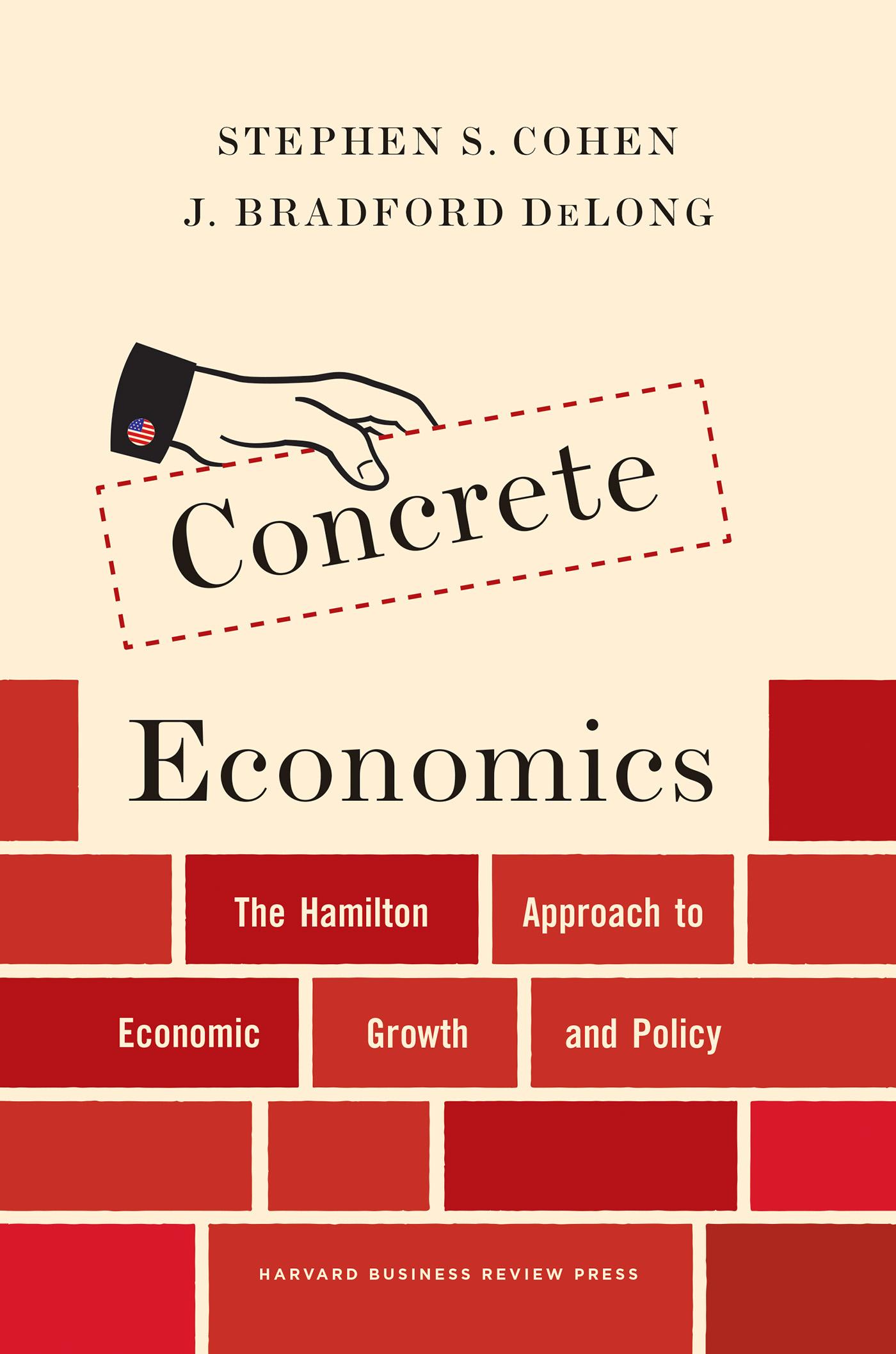
“an excellent new book” — Paul Krugman, The New York Times
History, not ideology, holds the key to growth.
Brilliantly written and argued, Concrete Economics shows how government has repeatedly reshaped the American economy ever since Alexander Hamilton’s first, foundational redesign.
This book does not rehash the sturdy and long-accepted arguments that to thrive, entrepreneurial economies need a broad range of freedoms. Instead, Steve Cohen and Brad DeLong remedy our national amnesia about how our economy has actually grown and the role government has played in redesigning and reinvigorating it throughout our history. The government not only sets the ground rules for entrepreneurial activity but directs the surges of energy that mark a vibrant economy. This is as true for present-day Silicon Valley as it was for New England manufacturing at the dawn of the nineteenth century.
The authors’ argument is not one based on abstract ideas, arcane discoveries, or complex correlations. Instead it is based on the facts—facts that were once well known but that have been obscured in a fog of ideology—of how the US economy benefited from a pragmatic government approach to succeed so brilliantly.
Understanding how our economy has grown in the past provides a blueprint for how we might again redesign and reinvigorate it today, for such a redesign is sorely needed.
History, not ideology, holds the key to growth.
Brilliantly written and argued, Concrete Economics shows how government has repeatedly reshaped the American economy ever since Alexander Hamilton’s first, foundational redesign.
This book does not rehash the sturdy and long-accepted arguments that to thrive, entrepreneurial economies need a broad range of freedoms. Instead, Steve Cohen and Brad DeLong remedy our national amnesia about how our economy has actually grown and the role government has played in redesigning and reinvigorating it throughout our history. The government not only sets the ground rules for entrepreneurial activity but directs the surges of energy that mark a vibrant economy. This is as true for present-day Silicon Valley as it was for New England manufacturing at the dawn of the nineteenth century.
The authors’ argument is not one based on abstract ideas, arcane discoveries, or complex correlations. Instead it is based on the facts—facts that were once well known but that have been obscured in a fog of ideology—of how the US economy benefited from a pragmatic government approach to succeed so brilliantly.
Understanding how our economy has grown in the past provides a blueprint for how we might again redesign and reinvigorate it today, for such a redesign is sorely needed.
Betaal eenvoudig met kaart, Klarna, Apple Pay of Google Pay. Niet tevreden? Je hebt altijd 14 dagen bedenktijd. Lees meer in onze voorwaarden. Heb je vragen, mail ons dan via hello@memmo.org.
Memmo maakt studeren makkelijker – waar je ook bent ter wereld. Wij brengen je cursusboeken en slimme studietools samen op één plek: samenvattingen, quizzen, podcasts en flashcards. En Ted, je studievriend die antwoord geeft op alles wat je je afvraagt. Meer dan 50.000 studenten studeren hier al – gebouwd om je sneller te laten leren en minder stress te geven.
Misschien vind je dit ook leuk
Koop het boek0