
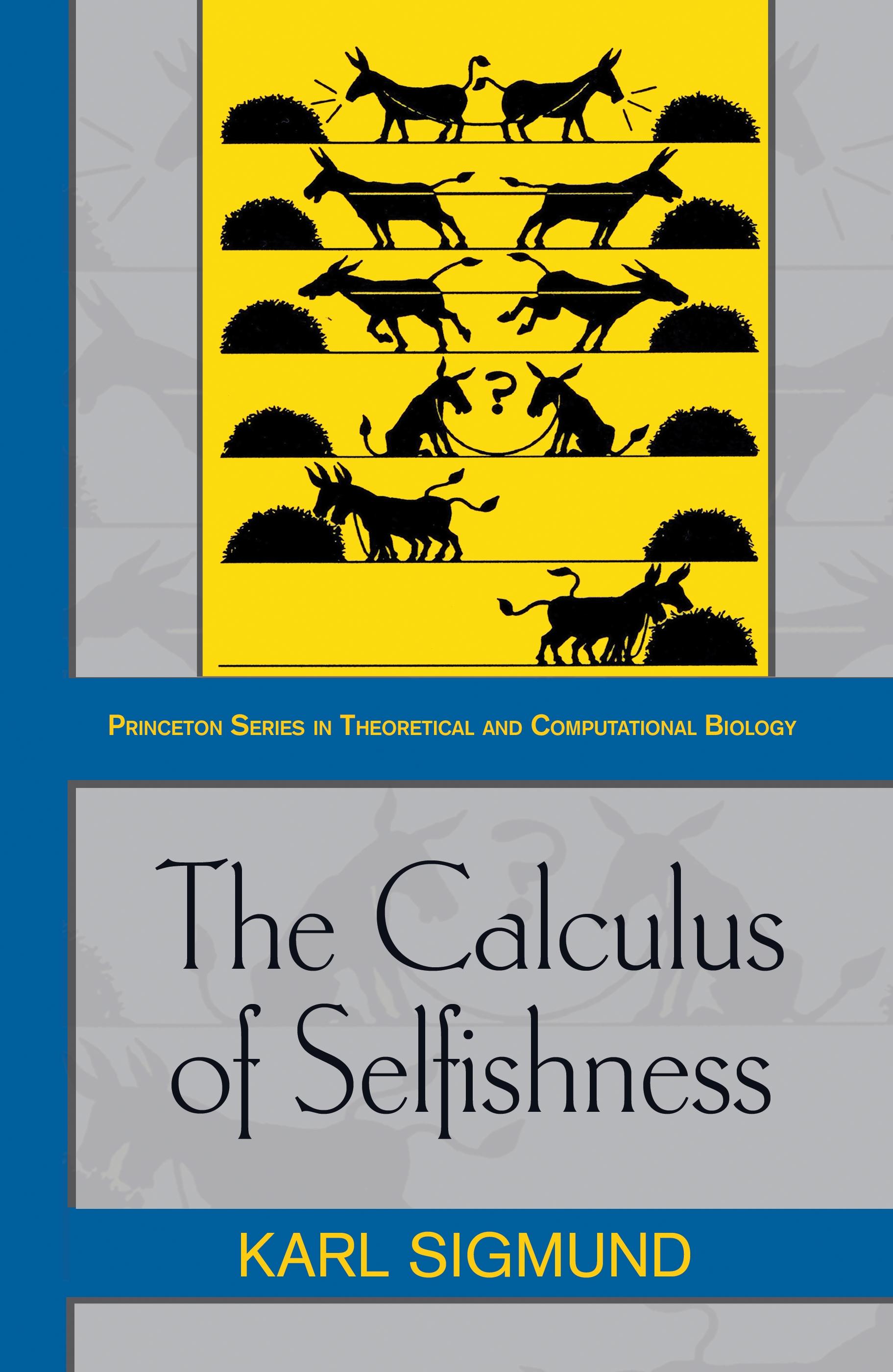
A pioneer in evolutionary game theory looks at selfishness and cooperation
How does cooperation emerge among selfish individuals? When do people share resources, punish those they consider unfair, and engage in joint enterprises? These questions fascinate philosophers, biologists, and economists alike, for the "invisible hand" that should turn selfish efforts into public benefit is not always at work. The Calculus of Selfishness looks at social dilemmas where cooperative motivations are subverted and self-interest becomes self-defeating. Karl Sigmund, a pioneer in evolutionary game theory, uses simple and well-known game theory models to examine the foundations of collective action and the effects of reciprocity and reputation.
Focusing on some of the best-known social and economic experiments, including games such as the Prisoner's Dilemma, Trust, Ultimatum, Snowdrift, and Public Good, Sigmund explores the conditions leading to cooperative strategies. His approach is based on evolutionary game dynamics, applied to deterministic and probabilistic models of economic interactions.
Exploring basic strategic interactions among individuals guided by self-interest and caught in social traps, The Calculus of Selfishness analyzes to what extent one key facet of human nature—selfishness—can lead to cooperation.
Betaal eenvoudig met kaart, Klarna, Apple Pay of Google Pay. Niet tevreden? Je hebt altijd 14 dagen bedenktijd. Lees meer in onze voorwaarden. Heb je vragen, mail ons dan via hello@memmo.org.
Memmo maakt studeren makkelijker – waar je ook bent ter wereld. Wij brengen je cursusboeken en slimme studietools samen op één plek: samenvattingen, quizzen, podcasts en flashcards. En Ted, je studievriend die antwoord geeft op alles wat je je afvraagt. Meer dan 50.000 studenten studeren hier al – gebouwd om je sneller te laten leren en minder stress te geven.