
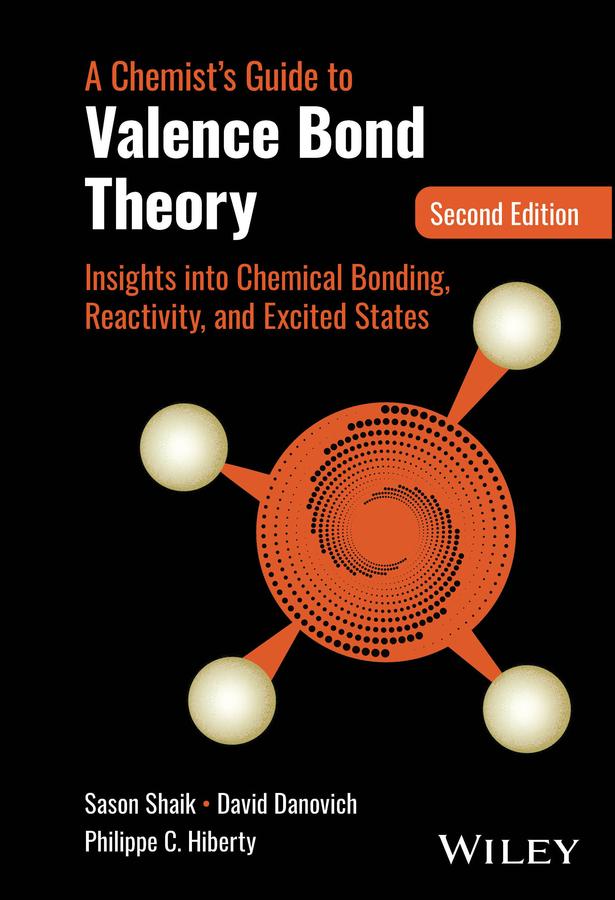
Updated resource on theoretical aspects and applications of valence bond methods to chemical calculations
A Chemist’s Guide to Valence Bond Theory explains how to use valence bond theory to think concisely and rigorously and how to use VB computations. It familiarizes the reader with the various VB-based computational tools and methods available today and their use for a given chemical problem and provides samples of inputs/outputs that instruct the reader on how to interpret the results. The book also covers the theoretical basis of Valence Bond (VB) theory and its applications to chemistry in the ground- and excited-states. Applications discussed in the book include sets of exercises and corresponding answers on bonding problems, organic reactions, inorganic/organometallic reactions, and bioinorganic/ biochemical reactions.
This Second Edition contains a new chapter on chemical bonds which includes sections on covalent, ionic, and charge-shift bonds as well as triplet bond pairs, a new chapter on the Breathing-Orbital VB method with its application to molecular excited states, and several new sections discussing recent developments such as DFT-based methods and solvent effects via the Polarizable Continuum Model (PCM).
A Chemist’s Guide to Valence Bond Theory includes information on:
- Writing and representing valence bond wave functions, overlaps between determinants, and valence bond formalism using the exact Hamiltonian
- Generating a set of valence bond structures and mapping a molecular orbital-configuration interaction wave function into a valence bond wave function
- The alleged “failures” of valence bond theory, such as the triplet ground state of dioxygen, and whether or not these failures are “real”
- Spin Hamiltonian valence bond theory and its applications to organic radicals, diradicals, and polyradicals
A Chemist’s Guide to Valence Bond Theory is an essential reference on the subject for chemists who are not necessarily experts on theory but have some background in quantum chemistry. The text is also appropriate for upper undergraduate and graduate students in advanced courses on valence bond theory.
Betaal eenvoudig met kaart, Klarna, Apple Pay of Google Pay. Niet tevreden? Je hebt altijd 14 dagen bedenktijd. Lees meer in onze voorwaarden. Heb je vragen, mail ons dan via hello@memmo.org.
Memmo maakt studeren makkelijker – waar je ook bent ter wereld. Wij brengen je cursusboeken en slimme studietools samen op één plek: samenvattingen, quizzen, podcasts en flashcards. En Ted, je studievriend die antwoord geeft op alles wat je je afvraagt. Meer dan 50.000 studenten studeren hier al – gebouwd om je sneller te laten leren en minder stress te geven.