
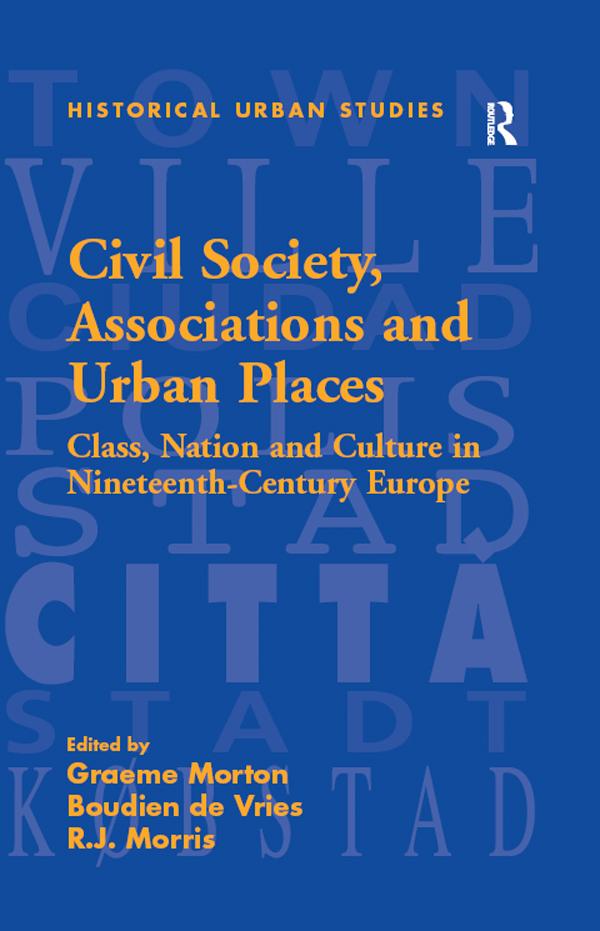
In recent years the concept of 'civil society' has become central to the historian's understanding of class, cultural and political power in the nineteenth-century town and city. Increasingly clubs and voluntary societies have been regarded as an important step in the formation of formal political parties, particularly for the working and middle classes. The result of this is the assertion that the more associations existing in a particular society, the deeper democracy becomes entrenched. In order to test this hypothesis, this volume brings together essays by an international group of urban historians who examine the construction of civil society from associational activity in the urban place. From their studies, it soon becomes clear that such simple propositions do not adequately reflect the dynamics of nineteenth-century urban society and politics. Urban associations were ideological in purpose and deliberately discriminatory and as such set the boundaries of civil society. Thus competing and segmented associations were not only an indication of pluralism and strength, but also highlighted a fundamental weakness when faced down by the interests of the state. Through a wide array of urban associations in a broad range of settings, comprising Austria and Bratislava, France and Italy, the Netherlands, Austro-Hungary, England, Scotland and the US, this volume reflects on the construction of class, nation and culture in the associations of the nineteenth-century urban place. In so doing it shows that a deep and interlocking civil society does not automatically lead to a rise in democratic activity. Expansion of the networks of urban association could equally result in greater subdivision and to the fragmentation and isolation of certain groups. Partition as much as coherence is our understanding of civil society and associations in the nineteenth-century urban place.
Pagina's: 240
Categorie: Historia
e-ISBN: 9781351951104
Verzendgewicht: 1.2 kg
Verzending binnen: 1-2 dagen
Betaal eenvoudig met kaart, Klarna, Apple Pay of Google Pay. Niet tevreden? Je hebt altijd 14 dagen bedenktijd. Lees meer in onze voorwaarden. Heb je vragen, mail ons dan via hello@memmo.org.
Memmo maakt studeren makkelijker – waar je ook bent ter wereld. Wij brengen je cursusboeken en slimme studietools samen op één plek: samenvattingen, quizzen, podcasts en flashcards. En Ted, je studievriend die antwoord geeft op alles wat je je afvraagt. Meer dan 50.000 studenten studeren hier al – gebouwd om je sneller te laten leren en minder stress te geven.
Misschien vind je dit ook leuk
Koop het boek0