
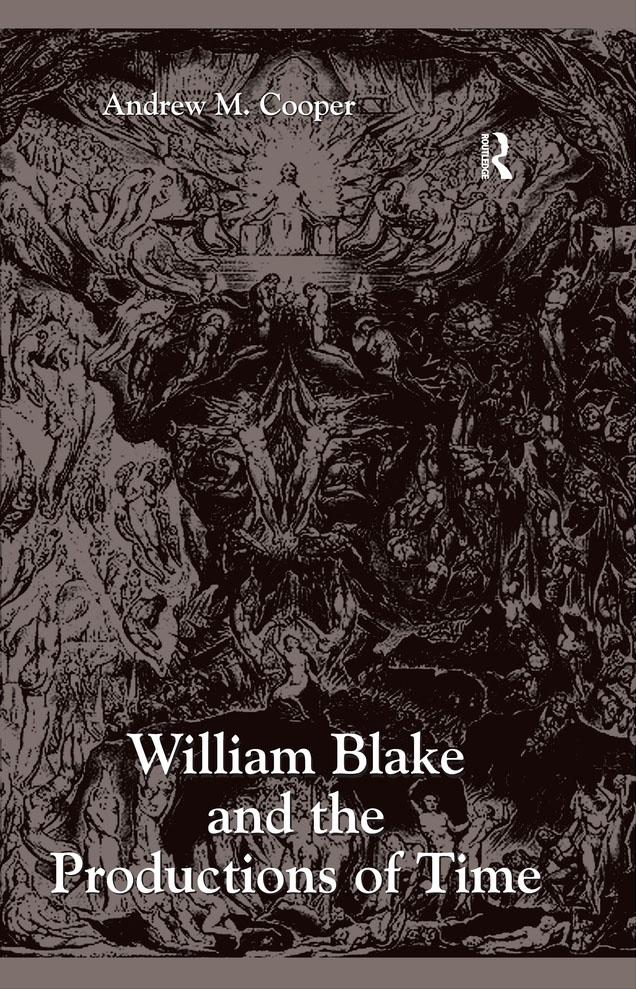
Challenging the idea that a writer’s work reflects his experiences in time and place, Andrew M. Cooper locates the action of William Blake’s major illuminated books in the ahistorical present, an impersonal spirit realm beyond the three-dimensional self. Blake, Cooper shows, was a formalist who exploited eighteenth-century scientific and philosophical research on vision, sense, and mind for spiritual purposes. Through irony, dialogism, two-way syntax, and synesthesia, Blake extended and refined the prophetic method Milton forged in Paradise Lost to bring the performativity of traditional oral song and storytelling into print. Cooper argues that historicist attempts to place Blake’s vision in perspective, as opposed to seeing it for oneself, involve a deeply self-contradictory denial of his performativity as a poet-artist. Rather, Blake’s expansion of linear reading into a space of creative, self-conscious collaboration laid the basis for his lifelong critique of dualism in religion and science, and anticipated the non-Euclidean geometrics of twentieth-century Modernism.
Pagina's: 362
Categorie: Litteraturvetenskap & Teori
e-ISBN: 9781351872928
Verzendgewicht: 1.2 kg
Verzending binnen: 1-2 dagen
Betaal eenvoudig met kaart, Klarna, Apple Pay of Google Pay. Niet tevreden? Je hebt altijd 14 dagen bedenktijd. Lees meer in onze voorwaarden. Heb je vragen, mail ons dan via hello@memmo.org.
Memmo maakt studeren makkelijker – waar je ook bent ter wereld. Wij brengen je cursusboeken en slimme studietools samen op één plek: samenvattingen, quizzen, podcasts en flashcards. En Ted, je studievriend die antwoord geeft op alles wat je je afvraagt. Meer dan 50.000 studenten studeren hier al – gebouwd om je sneller te laten leren en minder stress te geven.
Misschien vind je dit ook leuk
Koop het boek0