
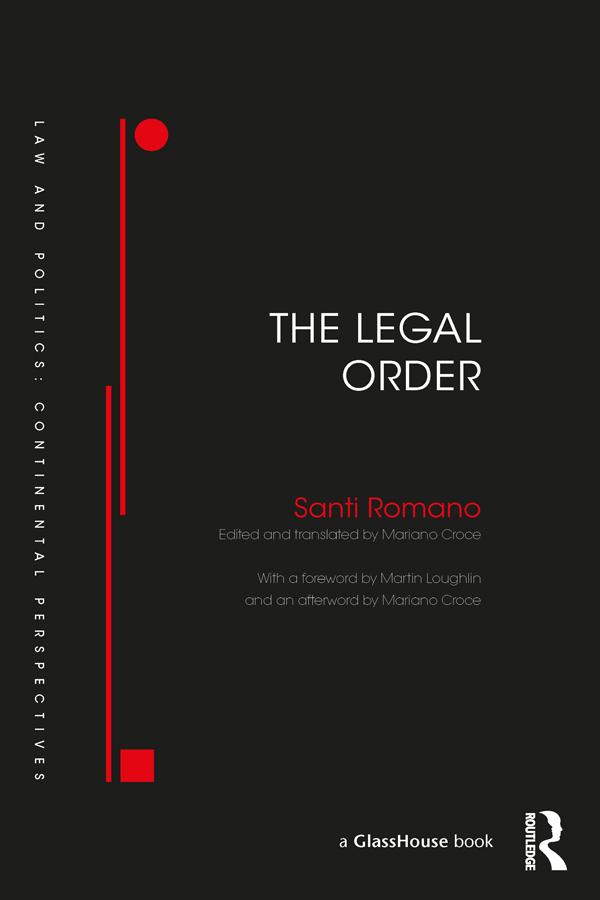
First published in 1917 (Part 1) and 1918 (Part 2), with a second edition in 1946, this is the first English translation of Santi Romano’s classic work, L’ordinamento giuridico (The Legal Order). The main focus of The Legal Order is the notion of institution, which Romano considers to be both the core and distinguishing feature of law. After criticising accounts of the nature of law centred on notions of rule, coercion or authority, he offers a compelling conception, not merely of law as an institution, but of the institution as ‘the first, original and essential manifestation of law’. Romano advances a definition of a legal institution as any group who share rules within a bounded context: for example, a family, a firm, a factory, a prison, an association, a church, an illegal organisation, a state, the community of states, and so on. Therefore, this understanding of legal institutionalism at the same time provides a ground-breaking theory of legal pluralism whereby ‘there are as many legal orders as institutions’. The acme of a jurisprudential current long overlooked in the Anglophone environment (Romano’s work is highly regarded in France, Germany, Spain and South America, as well as in Italy), The Legal Order not only proposes what Carl Schmitt described as a ‘very significant theory’. More importantly, it offers precious insights for a thorough rethinking of the relationship between law and society in today’s world.
Betaal eenvoudig met kaart, Klarna, Apple Pay of Google Pay. Niet tevreden? Je hebt altijd 14 dagen bedenktijd. Lees meer in onze voorwaarden. Heb je vragen, mail ons dan via hello@memmo.org.
Memmo maakt studeren makkelijker – waar je ook bent ter wereld. Wij brengen je cursusboeken en slimme studietools samen op één plek: samenvattingen, quizzen, podcasts en flashcards. En Ted, je studievriend die antwoord geeft op alles wat je je afvraagt. Meer dan 50.000 studenten studeren hier al – gebouwd om je sneller te laten leren en minder stress te geven.