
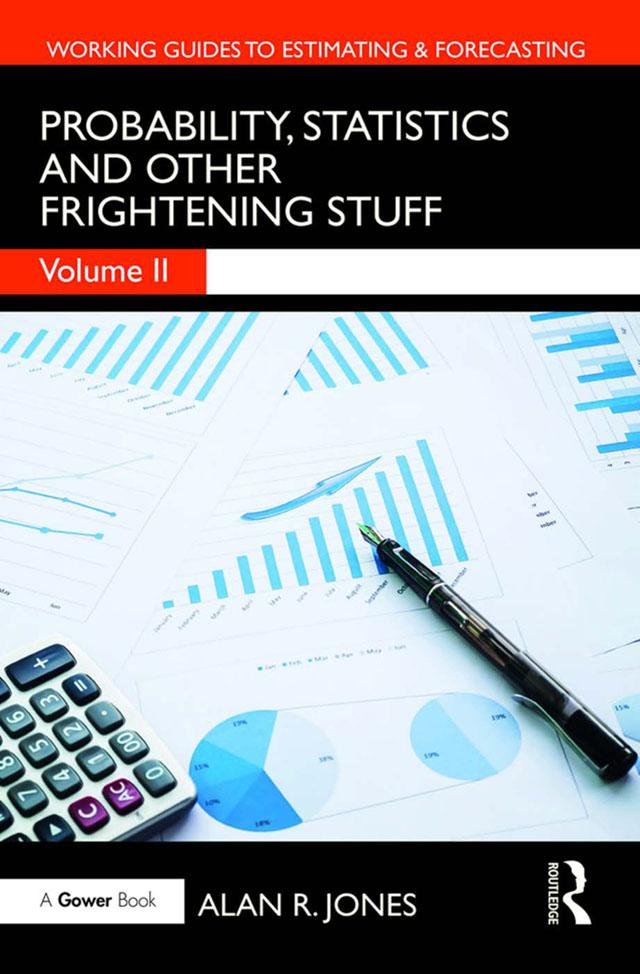
Probability, Statistics and Other Frightening Stuff (Volume II of the Working Guides to Estimating & Forecasting series) considers many of the commonly used Descriptive Statistics in the world of estimating and forecasting. It considers values that are representative of the ‘middle ground’ (Measures of Central Tendency), and the degree of data scatter (Measures of Dispersion and Shape) around the ‘middle ground’ values.
A number of Probability Distributions and where they might be used are discussed, along with some fascinating and useful ‘rules of thumb’ or short-cut properties that estimators and forecasters can exploit in plying their trade. With the help of a ‘Correlation Chicken’, the concept of partial correlation is explained, including how the estimator or forecaster can exploit this in reflecting varying levels of independence and imperfect dependence between an output or predicted value (such as cost) and an input or predictor variable such as size.
Under the guise of ‘Tails of the unexpected’ the book concludes with two chapters devoted to Hypothesis Testing (or knowing when to accept or reject the validity of an assumed estimating relationship), and a number of statistically-based tests to help the estimator to decide whether to include or exclude a data point as an ‘outlier’, one that appears not to be representative of that which the estimator is tasked to produce. This is a valuable resource for estimators, engineers, accountants, project risk specialists as well as students of cost engineering.
Betaal eenvoudig met kaart, Klarna, Apple Pay of Google Pay. Niet tevreden? Je hebt altijd 14 dagen bedenktijd. Lees meer in onze voorwaarden. Heb je vragen, mail ons dan via hello@memmo.org.
Memmo maakt studeren makkelijker – waar je ook bent ter wereld. Wij brengen je cursusboeken en slimme studietools samen op één plek: samenvattingen, quizzen, podcasts en flashcards. En Ted, je studievriend die antwoord geeft op alles wat je je afvraagt. Meer dan 50.000 studenten studeren hier al – gebouwd om je sneller te laten leren en minder stress te geven.