
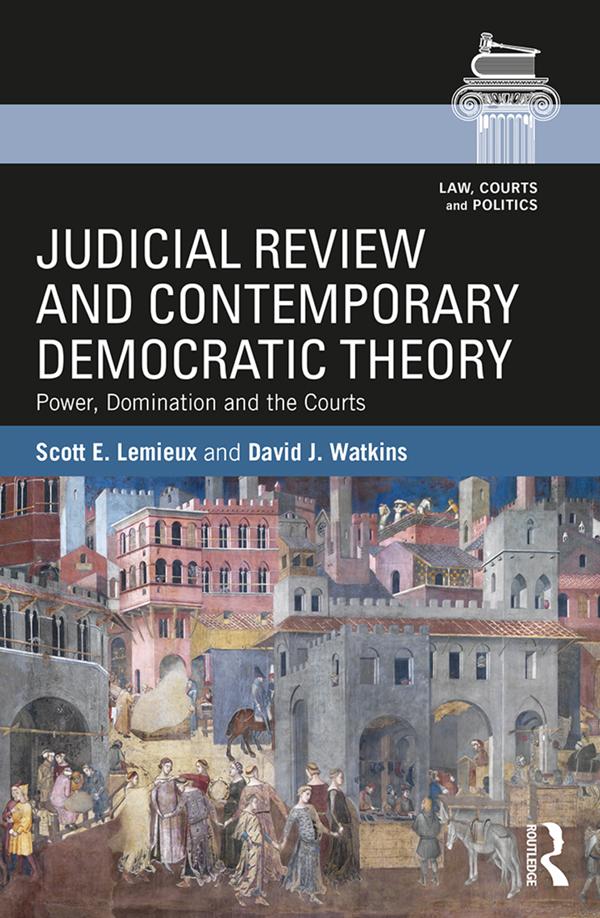
For decades, the question of judicial review’s status in a democratic political system has been adjudicated through the framework of what Alexander Bickel labeled "the counter-majoritarian difficulty." That is, the idea that judicial review is particularly problematic for democracy because it opposes the will of the majority.
Judicial Review and Contemporary Democratic Theory begins with an assessment of the empirical and theoretical flaws of this framework, and an account of the ways in which this framework has hindered meaningful investigation into judicial review’s value within a democratic political system. To replace the counter-majoritarian difficulty framework, Scott E. Lemieux and David J. Watkins draw on recent work in democratic theory emphasizing democracy’s opposition to domination and analyses of constitutional court cases in the United States, Canada, and elsewhere to examine judicial review in its institutional and political context.
Developing democratic criteria for veto points in a democratic system and comparing them to each other against these criteria, Lemieux and Watkins yield fresh insights into judicial review’s democratic value. This book is essential reading for students of law and courts, judicial politics, legal theory and constitutional law.
Betaal eenvoudig met kaart, Klarna, Apple Pay of Google Pay. Niet tevreden? Je hebt altijd 14 dagen bedenktijd. Lees meer in onze voorwaarden. Heb je vragen, mail ons dan via hello@memmo.org.
Memmo maakt studeren makkelijker – waar je ook bent ter wereld. Wij brengen je cursusboeken en slimme studietools samen op één plek: samenvattingen, quizzen, podcasts en flashcards. En Ted, je studievriend die antwoord geeft op alles wat je je afvraagt. Meer dan 50.000 studenten studeren hier al – gebouwd om je sneller te laten leren en minder stress te geven.