
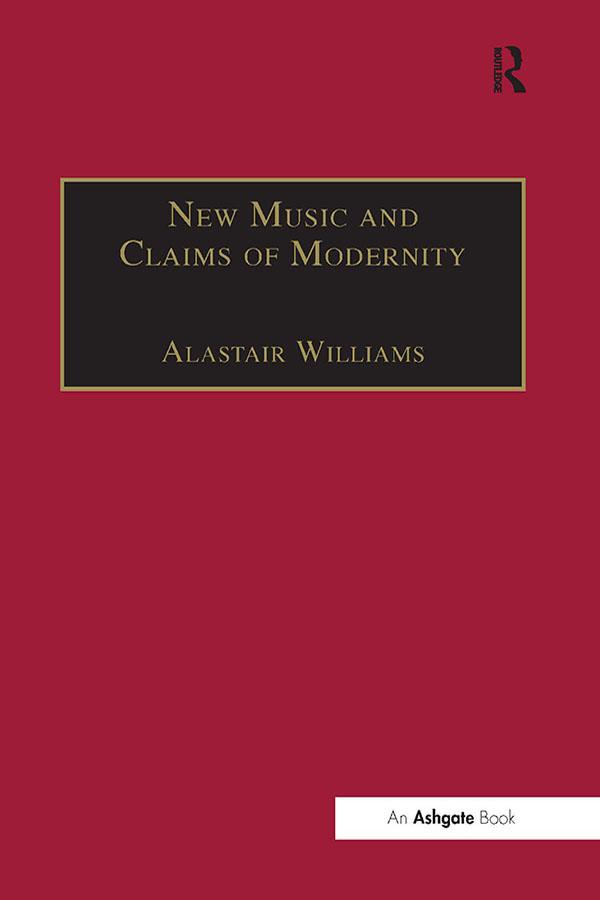
Since 1945 the emphasis in new music has lain in a desire for progress, a concept challenged by postmodernist aesthetics. In this study, Alastair Williams identifies and explores the recurring issues and problems presented by post-war music. Part one examines the German philosopher, Theodor Adorno's portrayal of modernity and his understanding of modernism in music. This is followed by a survey of the developments in music from late Beethoven to Schoenberg, the two composers whose works provided the main anchor points for Adorno's philosophy of music. Parts two and three indicate the ways in which Adorno's aesthetics are pertinent to an understanding of new music. Part two comprises a close examination of the music of Pierre Boulez and John Cage, composers who represent extreme, though related, aspects of contemporary music thought: the primacy of structure versus dissolution. Williams' views the music of Ligeti as an exploration of the interface between these two extremes, personifying Adorno's advocation of an aesthetic which attempts to embrace all its dissimilar parts. In part three the consequences of modernism and the aesthetic approaches of Derrida and de Mann are considered, together with the music of Wolfgang Rihm. Williams concludes with a survey of contemporary music and the postmodernist desire to include a range of compositional references.
Betaal eenvoudig met kaart, Klarna, Apple Pay of Google Pay. Niet tevreden? Je hebt altijd 14 dagen bedenktijd. Lees meer in onze voorwaarden. Heb je vragen, mail ons dan via hello@memmo.org.
Memmo maakt studeren makkelijker – waar je ook bent ter wereld. Wij brengen je cursusboeken en slimme studietools samen op één plek: samenvattingen, quizzen, podcasts en flashcards. En Ted, je studievriend die antwoord geeft op alles wat je je afvraagt. Meer dan 50.000 studenten studeren hier al – gebouwd om je sneller te laten leren en minder stress te geven.
Misschien vind je dit ook leuk
Koop het boek0