
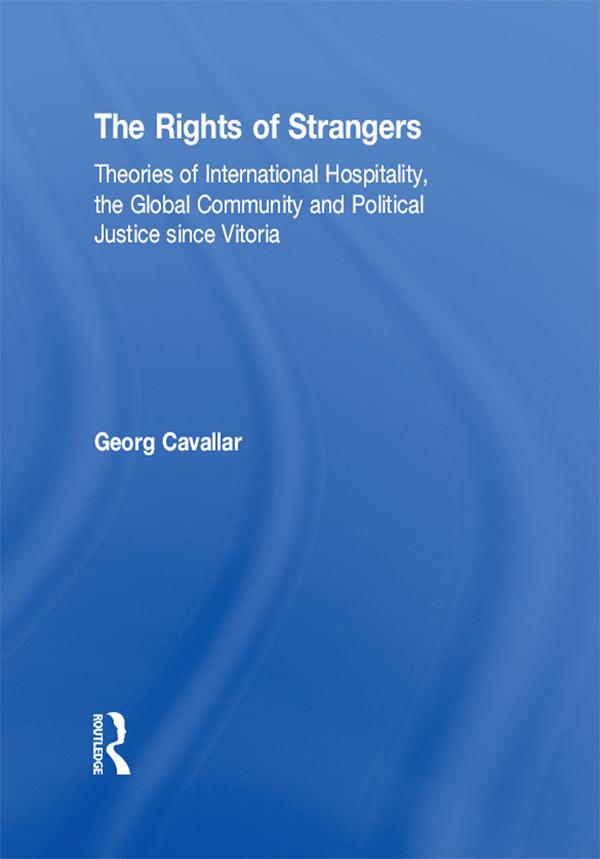
This study investigates the thinking of European authors from Vitoria to Kant about political justice, the global community, and the rights of strangers as one special form of interaction among individuals of divergent societies, political communities, and cultures. Taking an interdisciplinary approach, it covers historical material from a predominantly philosophical perspective, interpreting authors who have tackled problems related to the rights of strangers under the heading of international hospitality. Their analyses of the civitas maxima or the societas humani generis covered the nature of the global commonwealth. Their doctrines of natural law (ius naturae) were supposed to provide what we nowadays call theories of political justice. The focus of the work is on international hospitality as part of the law of nations, on its scope and justification. It follows the political ideas of Francisco de Vitoria and the Second Scholastic in the 16th century, of Alberico Gentili, Hugo Grotius, Samuel Pufendorf, Christian Wolff, Emer de Vattel, Johann Jacob Moser, and Immanuel Kant. It draws attention to the international dimension of political thought in Thomas Hobbes, John Locke, Jean-Jacques Rousseau, David Hume, Adam Smith, and others. This is predominantly a study in intellectual history which contextualizes ideas, but also emphasizes their systematic relevance.
Betaal eenvoudig met kaart, Klarna, Apple Pay of Google Pay. Niet tevreden? Je hebt altijd 14 dagen bedenktijd. Lees meer in onze voorwaarden. Heb je vragen, mail ons dan via hello@memmo.org.
Memmo maakt studeren makkelijker – waar je ook bent ter wereld. Wij brengen je cursusboeken en slimme studietools samen op één plek: samenvattingen, quizzen, podcasts en flashcards. En Ted, je studievriend die antwoord geeft op alles wat je je afvraagt. Meer dan 50.000 studenten studeren hier al – gebouwd om je sneller te laten leren en minder stress te geven.
Misschien vind je dit ook leuk
Koop het boek0