
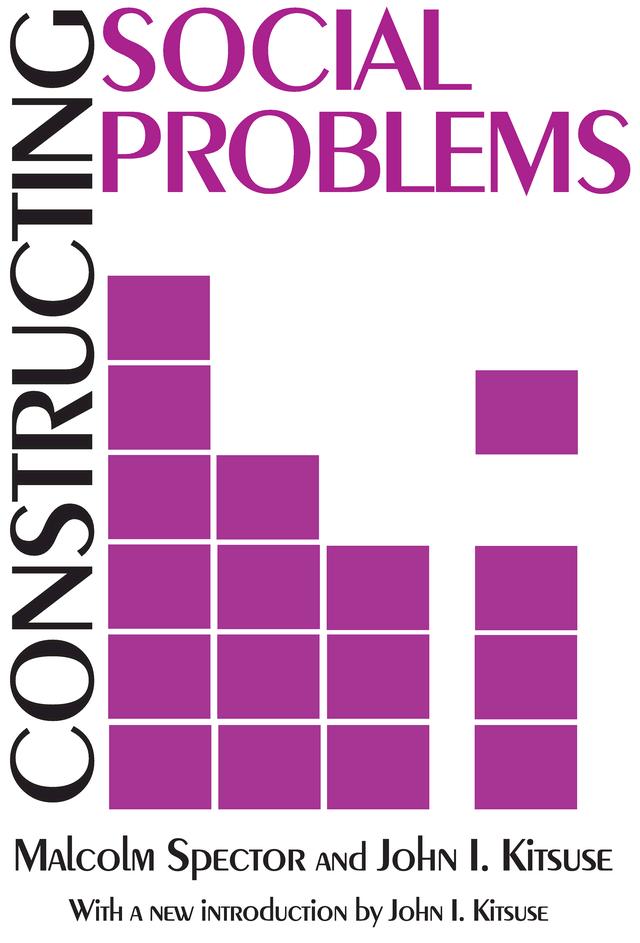
There is no adequate definition of social problems within sociology, and there is not and never has been a sociology of social problems. That observation is the point of departure of this book. The authors aim to provide such a definition and to prepare the ground for the empirical study of social problems. They are aware that their objective will strike many fellow sociologists as ambitious, perhaps even arrogant. Their work challenges sociologists who have, over a period of fifty years, written treatises on social problems, produced textbooks cataloguing the nature, distribution, and causes of these problems, and taught many sociology courses. It is only natural that the authors' work will be viewed as controversial in light of the large literature which has established a "sociology of" a wide range of social problems-the sociology of race relations, prostitution, poverty, crime, mental illness, and so forth. In the 1970s when the authors were preparing for a seminar on the sociology of social problems, their review of the "literature" revealed the absence of any systematic, coherent statement of theory or method in the study of social problems. For many years the subject was listed and offered by university departments of sociology as a "service course" to present undergraduates with what they should know about the various "social pathologies" that exist in their society. This conception of social problems for several decades has been reflected in the substance and quality of the literature dominated by textbooks. In 'Constructing Social Problems', the authors propose that social problems be conceived as the claims-making activities of individuals or groups regarding social conditions they consider unjust, immoral, or harmful and that should be addressed. This perspective, as the authors have formulated it, conceives of social problems as a process of interaction that produces social problems as social facts in society. The authors further propose that this process and the social facts it produces are the data to be researched for the sociology of social problems. This volume will be of interest to those concerned with the discipline of sociology, especially its current theoretical development and growth.
Betaal eenvoudig met kaart, Klarna, Apple Pay of Google Pay. Niet tevreden? Je hebt altijd 14 dagen bedenktijd. Lees meer in onze voorwaarden. Heb je vragen, mail ons dan via hello@memmo.org.
Memmo maakt studeren makkelijker – waar je ook bent ter wereld. Wij brengen je cursusboeken en slimme studietools samen op één plek: samenvattingen, quizzen, podcasts en flashcards. En Ted, je studievriend die antwoord geeft op alles wat je je afvraagt. Meer dan 50.000 studenten studeren hier al – gebouwd om je sneller te laten leren en minder stress te geven.
Misschien vind je dit ook leuk
Koop het boek0