
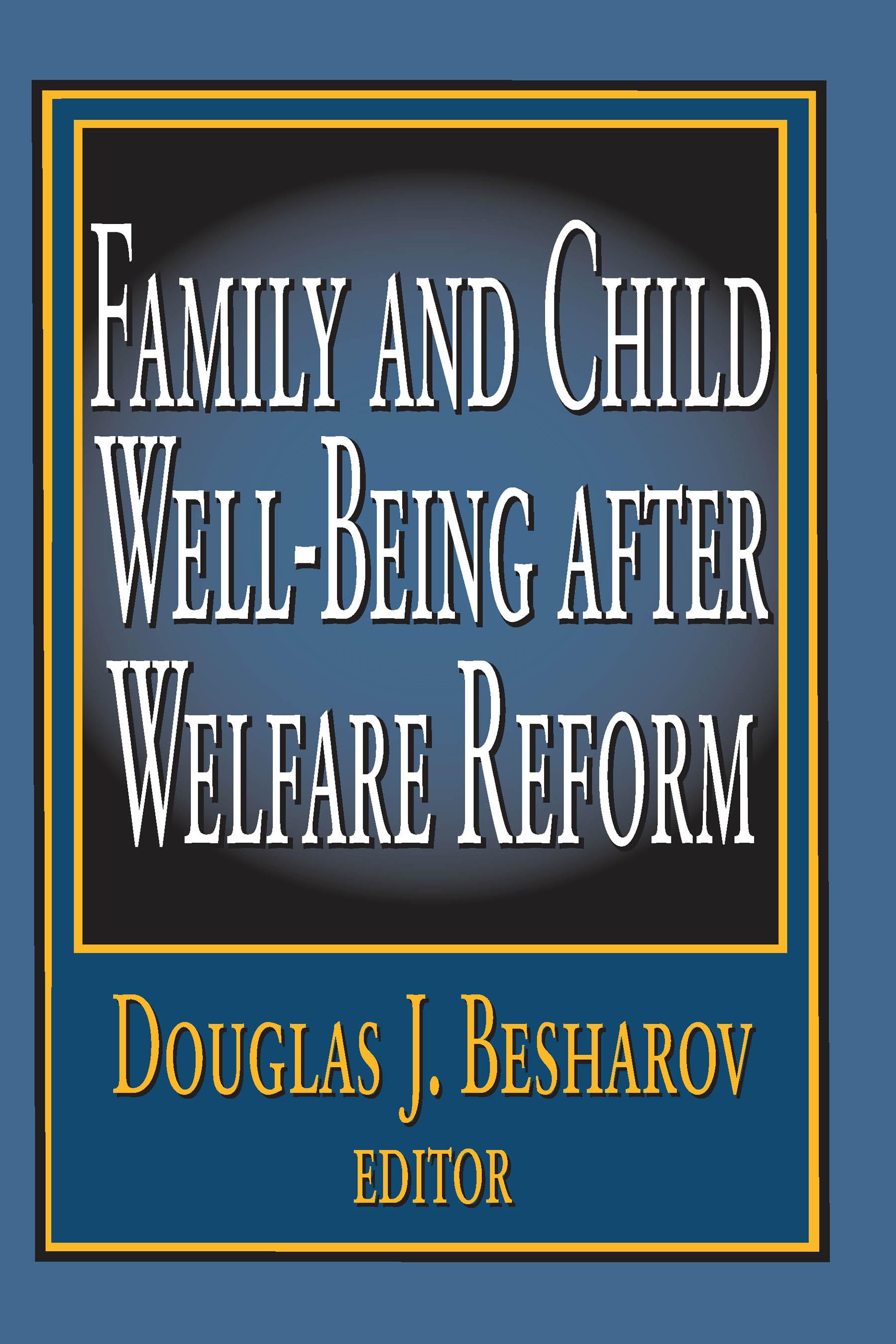
Since their historic high in 1994, welfare caseloads in the United States have dropped an astounding 59 percent--more than 5 million fewer families receive welfare. Family and Child Well-Being after Welfare Reform, now in paperback, explores how low-income children and their families are faring in the wake of welfare reform. Contributors to the volume include leading social researchers. Can existing surveys and other data be used to measure trends in the area? What key indicators should be tracked? What are the initial trends after welfare reform? What other information or approaches would be helpful? The book covers a broad range of topics: an update on welfare reform (Douglas J. Besharov and Peter Germanis); ongoing major research (Peter H. Rossi); material well-being, such as earnings, benefits, and consumption (Richard Bavier); family versus household (Wendy D. Manning); fatherhood, cohabitation, and marriage (Wade F. Horn); teenage sex, pregnancy, and nonmarital births (Isabel V. Sawhill); child maltreatment and foster care (Richard J. Gelles); homelessness and housing (John C. Weicher); child health and well-being (Lorraine V. Klerman); nutrition, food security, and obesity (Harold S. Beebout); crime, juvenile delinquency, and dysfunctional behavior (Lawrence W. Sherman); drug use (Peter Reuter); mothers' work and child care (Julia B. Isaacs); and the activities of the U.S. Department of Health and Human Services (Don Winstead and Ann McCormick). When welfare reform was first debated, many people feared that it would hurt the poor, especially children. The contributors find little evidence to suggest this has occurred. As time limits and other programmatic requirements take hold, more information will be needed to assess the condition of low-income families after welfare reform. This informative volume establishes a baseline for that assessment.
Pagina's: 305
Categorie: Samhällsvetenskap
e-ISBN: 9781351520508
Verzendgewicht: 1.2 kg
Verzending binnen: 1-2 dagen
Betaal eenvoudig met kaart, Klarna, Apple Pay of Google Pay. Niet tevreden? Je hebt altijd 14 dagen bedenktijd. Lees meer in onze voorwaarden. Heb je vragen, mail ons dan via hello@memmo.org.
Memmo maakt studeren makkelijker – waar je ook bent ter wereld. Wij brengen je cursusboeken en slimme studietools samen op één plek: samenvattingen, quizzen, podcasts en flashcards. En Ted, je studievriend die antwoord geeft op alles wat je je afvraagt. Meer dan 50.000 studenten studeren hier al – gebouwd om je sneller te laten leren en minder stress te geven.
Misschien vind je dit ook leuk
Koop het boek0