
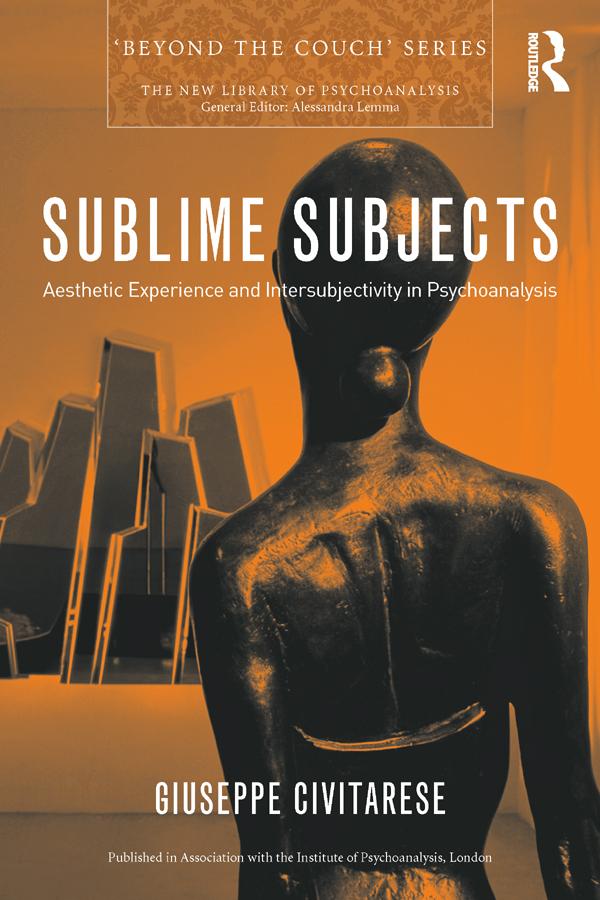
Sublime Subjects explores two fundamental questions: what is the start of humanity? When and how does a newborn child become a subject? These are relevant to psychoanalysis not only theoretically, but also in clinical practice, where the issue at stake is how to help the analysand’s mind to grow or, better, to increase the ability to give a meaning to experience.
Giuseppe Civitarese here argues that the psychoanalytic theory of sublimation and the aesthetic theory of the sublime are theories of subjectivation that can illuminate each other and give us a better understanding of the birth of the psyche. The aesthetic experience in art and in psychoanalytic practice are concerned with the social constitution of the individual, understood at its pre-reflective, non-verbal or inter-corporeal level. It is at this level that, thanks to the encounter with a receptive other, the turbulences of sensations and proto-emotions become soothing rhythms, proto-ideas or sensible ideas at first and, once words are added, concepts.
In Bionian terms, the at-one-ment between mother and baby is a form of primordial abstraction and occurs first in the dimension of the purely sensory and indistinct, and then in the affective space, which nonetheless is always a symbolic space if we take account that sociality is provided for the couple-system by the mother. It is exactly the intersubjective process of elevating toward conceptual thinking, but without ever detaching oneself from the thinking deposited in the body as procedural knowledge, that justifies the definition adopted here of human beings as Sublime Subjects.
This book explores these topics not only through the lens of the concept of sublimation or the theory of the sublime, but also through those of masochism, hypochondria, truth and two readings of classical Freudian papers such as the clinical case of Dora and ‘Formulations on the two principles of mental functioning’. Sublime Subjects will appeal to psychoanalysts and psychoanalytic psychotherapists, as well as literature and philosophy scholars.
Betaal eenvoudig met kaart, Klarna, Apple Pay of Google Pay. Niet tevreden? Je hebt altijd 14 dagen bedenktijd. Lees meer in onze voorwaarden. Heb je vragen, mail ons dan via hello@memmo.org.
Memmo maakt studeren makkelijker – waar je ook bent ter wereld. Wij brengen je cursusboeken en slimme studietools samen op één plek: samenvattingen, quizzen, podcasts en flashcards. En Ted, je studievriend die antwoord geeft op alles wat je je afvraagt. Meer dan 50.000 studenten studeren hier al – gebouwd om je sneller te laten leren en minder stress te geven.