
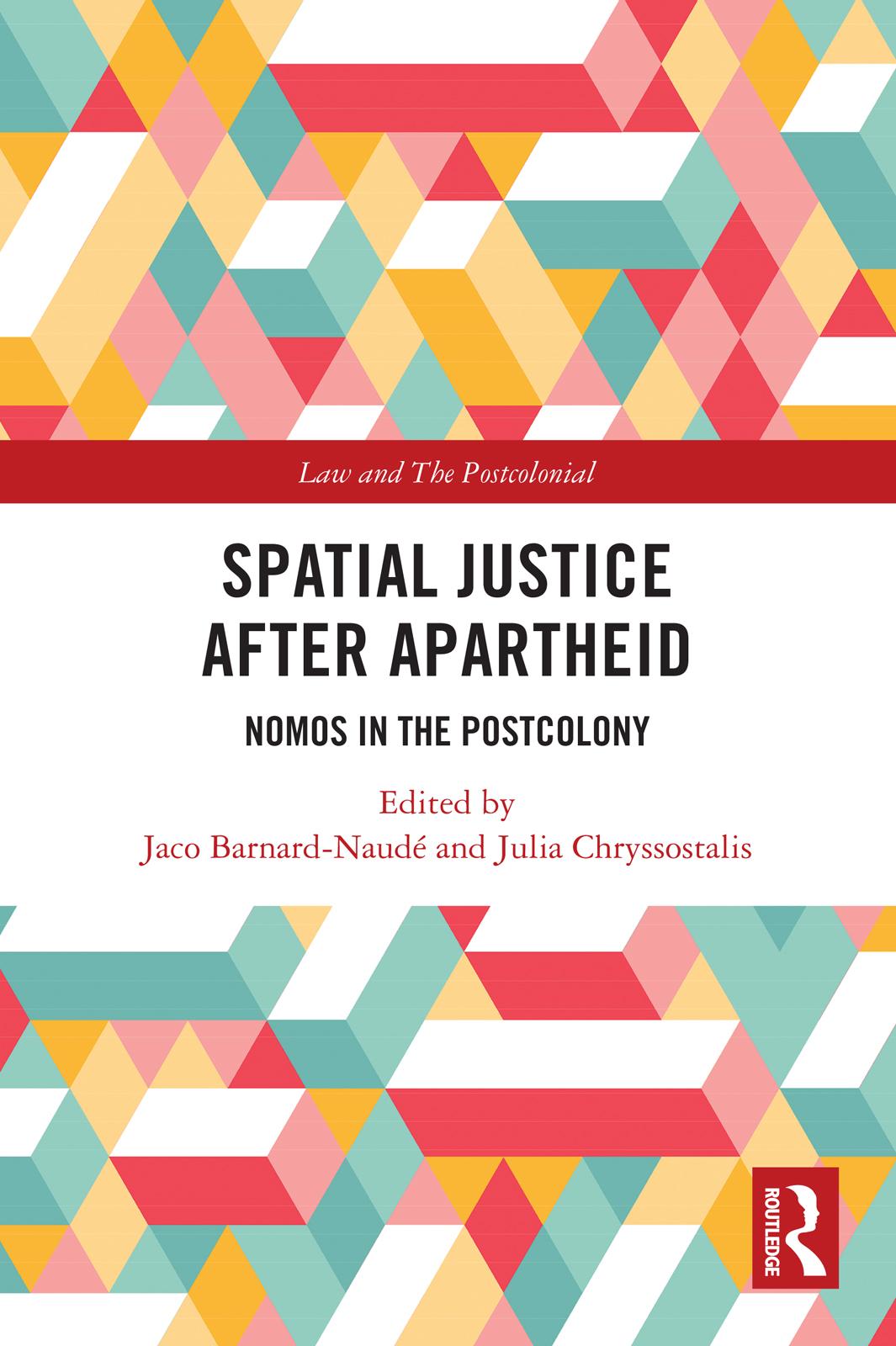
This book considers the question of spatial justice after apartheid from several disciplinary perspectives – jurisprudence, law, literature, architecture, photography and psychoanalysis are just some of the disciplines engaged here. However, the main theoretical device on which the authors comment is the legacy of what in Carl Schmitt’s terms is nomos as the spatialised normativity of sociality. Each author considers within the practical and theoretical constraints of their topic, the question of what nomos in its modern configuration may or may not contribute to a thinking of spatial justice after apartheid.
On the whole, the collection forces a confrontation between law’s spatiality in a “postcolonial” era, on the one hand, and the traumatic legacy of what Paul Gilroy has called the “colonial nomos”, on the other hand. In the course of this confrontation, critical questions of continuation, extension, disruption and rewriting are raised and confronted in novel and innovative ways that both challenge Schmitt’s account of nomos and affirm the centrality of the constitutive relation between law and space. The book promises to resituate the trajectory of nomos, while considering critical instances through which the spatial legacy of apartheid might at last be overcome.
This interdisciplinary book will appeal to scholars of critical legal theory, political philosophy, aesthetics and architecture.
Betaal eenvoudig met kaart, Klarna, Apple Pay of Google Pay. Niet tevreden? Je hebt altijd 14 dagen bedenktijd. Lees meer in onze voorwaarden. Heb je vragen, mail ons dan via hello@memmo.org.
Memmo maakt studeren makkelijker – waar je ook bent ter wereld. Wij brengen je cursusboeken en slimme studietools samen op één plek: samenvattingen, quizzen, podcasts en flashcards. En Ted, je studievriend die antwoord geeft op alles wat je je afvraagt. Meer dan 50.000 studenten studeren hier al – gebouwd om je sneller te laten leren en minder stress te geven.