
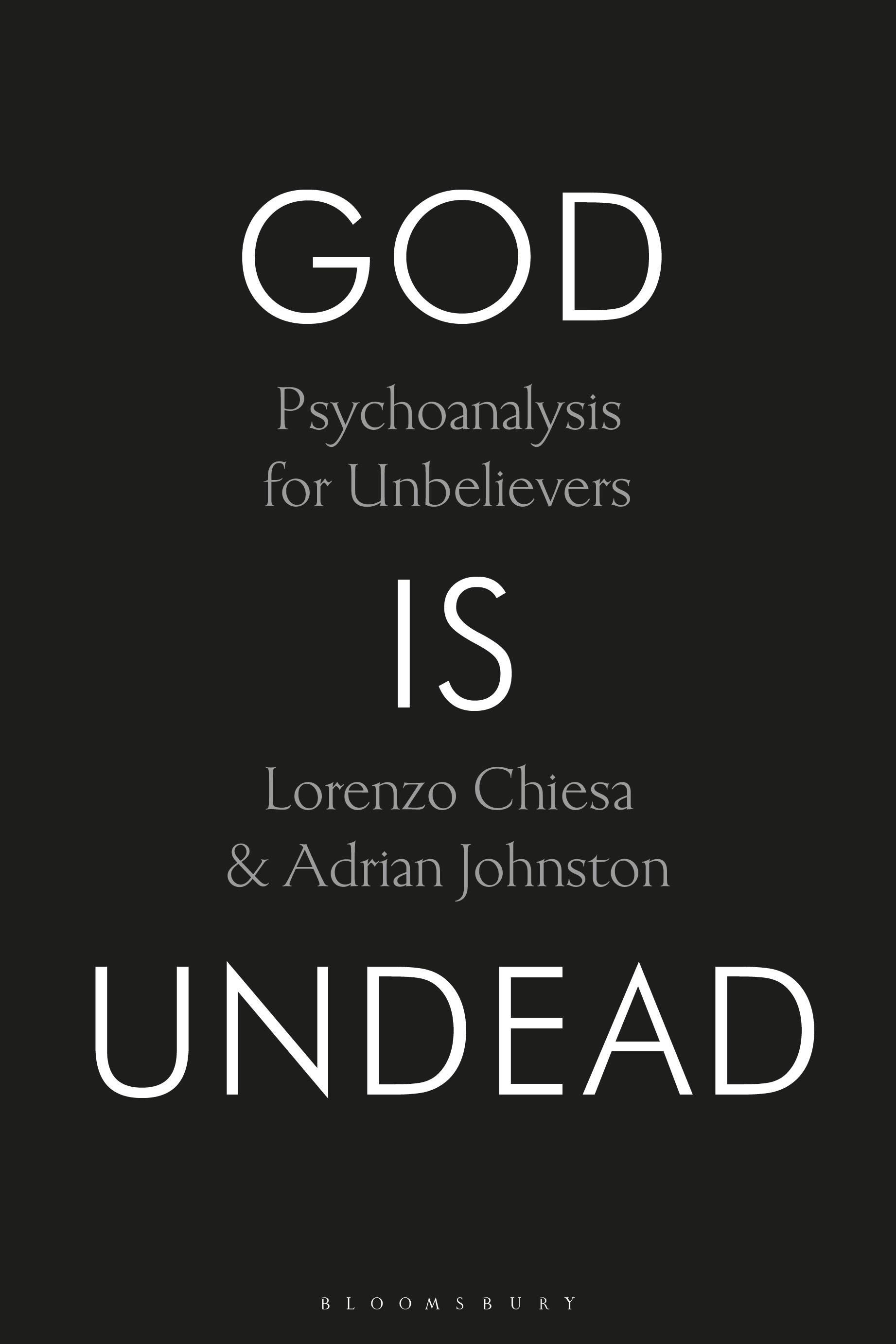
The undead are neither alive nor dead. They are animate yet non-living. In God Is Undead, Lorenzo Chiesa and Adrian Johnston contend that true unbelief today sees the divine precisely as exemplifying such undeath.
In God Is Undead, Chiesa and Johnston delve into and deepen the insights of both Freudian and Lacanian psychoanalysis as regards unbelief. This analytic perspective reveals that modern atheisms appealing to a scientific worldview as an antidote to orthodox religious faith end up as heterodox theisms of Nature, Reason, Knowledge, or even the Market itself. They ironically place new gods of their own atop the graves of the traditional gods of old. They likewise forget the religious influences underlying modern science.
One of the most important and novel contributions of God Is Undead is its gesture of dignifying unbelief as something that is able to contain multitudes. Far from a unified, homogeneous, and flatly bleak position, irreligiosity can come in many forms whose convergences and divergences contain possibilities for creatively thinking and living differently. This book shows such variegated non-belief in action. We have two unbelievers vigorously disagreeing with each other about fundamental ontological matters, thereby bringing to light critical questions going to the very heart of any unbelief whatsoever: Can an atheism, as thoroughly atheistic, ever believe in or be certain of itself? What is the role of agnosticism, and specifically of an agnosticism strengthening (rather than contrasting with) atheism, in all this? How might different unbelievers become what Freud calls “comrades in unbelief” without erecting new gods in the process?
In God Is Undead, Chiesa and Johnston delve into and deepen the insights of both Freudian and Lacanian psychoanalysis as regards unbelief. This analytic perspective reveals that modern atheisms appealing to a scientific worldview as an antidote to orthodox religious faith end up as heterodox theisms of Nature, Reason, Knowledge, or even the Market itself. They ironically place new gods of their own atop the graves of the traditional gods of old. They likewise forget the religious influences underlying modern science.
One of the most important and novel contributions of God Is Undead is its gesture of dignifying unbelief as something that is able to contain multitudes. Far from a unified, homogeneous, and flatly bleak position, irreligiosity can come in many forms whose convergences and divergences contain possibilities for creatively thinking and living differently. This book shows such variegated non-belief in action. We have two unbelievers vigorously disagreeing with each other about fundamental ontological matters, thereby bringing to light critical questions going to the very heart of any unbelief whatsoever: Can an atheism, as thoroughly atheistic, ever believe in or be certain of itself? What is the role of agnosticism, and specifically of an agnosticism strengthening (rather than contrasting with) atheism, in all this? How might different unbelievers become what Freud calls “comrades in unbelief” without erecting new gods in the process?
Betaal eenvoudig met kaart, Klarna, Apple Pay of Google Pay. Niet tevreden? Je hebt altijd 14 dagen bedenktijd. Lees meer in onze voorwaarden. Heb je vragen, mail ons dan via hello@memmo.org.
Memmo maakt studeren makkelijker – waar je ook bent ter wereld. Wij brengen je cursusboeken en slimme studietools samen op één plek: samenvattingen, quizzen, podcasts en flashcards. En Ted, je studievriend die antwoord geeft op alles wat je je afvraagt. Meer dan 50.000 studenten studeren hier al – gebouwd om je sneller te laten leren en minder stress te geven.