
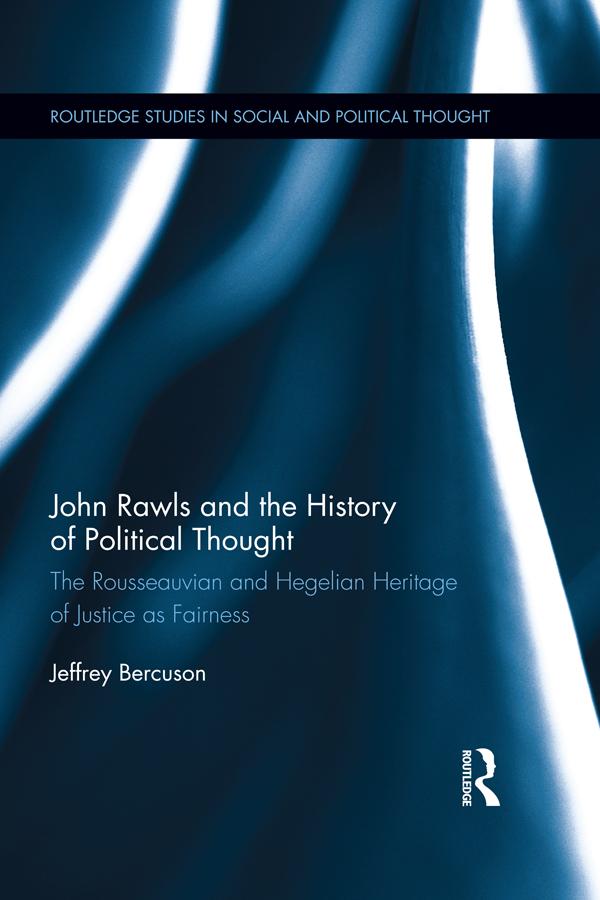
In this book, Jeffrey Bercuson presents the immense, and yet for the most part unrecognized, influences of Jean-Jacques Rousseau and Georg Wilhelm Friedrich Hegel on John Rawls, the most important political philosopher of the 20th century. While the well-documented influence of Immanuel Kant on Rawls is deep and profound, Kantian features and interpretation of justice as fairness do not tell the whole story about that doctrine.
Drawing on Rawls’s Lectures on the History of Moral Philosophy and his Lectures on the History of Political Philosophy, Bercuson presents the reader with a more nuanced, accurate account of the moral and political philosophy of Rawls in light of these under-appreciated influences. This new, richer image of Rawls’s political philosophy shows that Rawls’s notion of reasonableness – his notion of the kind and extent of our obligations to those fellows with whom we are engaged in social cooperation – is conspicuously more demanding, and therefore more attractive, than most interpreters and critics assume. Rawls turns to Rousseau and to Hegel, both of whom provide attractive images of engaged citizenship worthy of emulation.
Written accessibly, and contributing to key contemporary debates of global justice, this book will be read by scholars within the fields of social and political theory, ethics, and philosophy.
Betaal eenvoudig met kaart, Klarna, Apple Pay of Google Pay. Niet tevreden? Je hebt altijd 14 dagen bedenktijd. Lees meer in onze voorwaarden. Heb je vragen, mail ons dan via hello@memmo.org.
Memmo maakt studeren makkelijker – waar je ook bent ter wereld. Wij brengen je cursusboeken en slimme studietools samen op één plek: samenvattingen, quizzen, podcasts en flashcards. En Ted, je studievriend die antwoord geeft op alles wat je je afvraagt. Meer dan 50.000 studenten studeren hier al – gebouwd om je sneller te laten leren en minder stress te geven.