
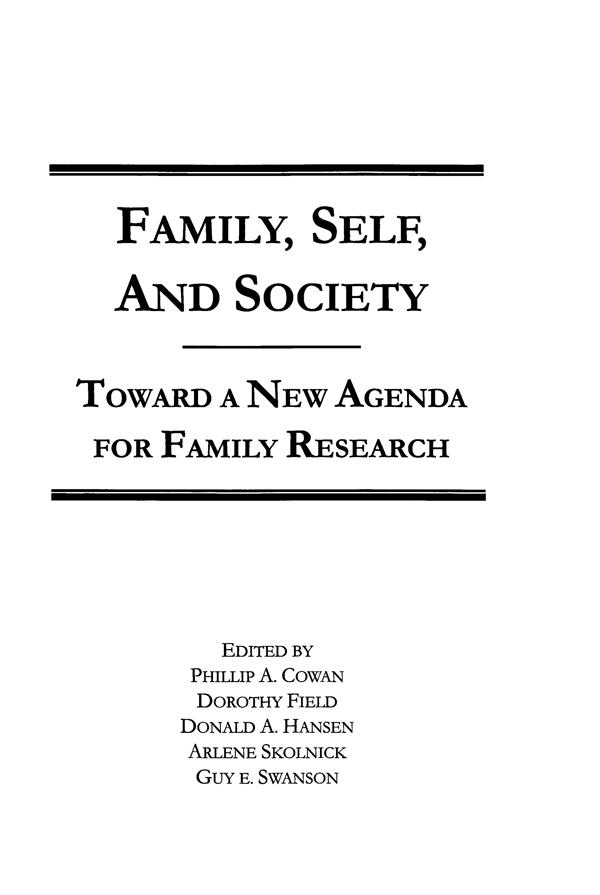
Any agenda for family research in the 1990s must take seriously a contextual approach to the study of family relationships. The editors and contributors to this volume believe that the richness in family studies over the next decade will come from considering the diversity of family forms -- different ethnic groups and cultures, different stages of family life, as well as different historical cohorts. Their goal is to make more explicit how we think about families in order to study them and understand them. To illustrate the need for diversity in family studies, examples are presented from new and old families, majority and minority families, American and Japanese families, and intact and divorcing families. This variety is intended to push the limits of current thinking, not only for researchers but also for all who are struggling to live with and work with families in a time when family life is valued but fragmented and relatively unsupported by society's institutions. Students and researchers interested in family development from the viewpoint of any of the social sciences will find this book of value.
Betaal eenvoudig met kaart, Klarna, Apple Pay of Google Pay. Niet tevreden? Je hebt altijd 14 dagen bedenktijd. Lees meer in onze voorwaarden. Heb je vragen, mail ons dan via hello@memmo.org.
Memmo maakt studeren makkelijker – waar je ook bent ter wereld. Wij brengen je cursusboeken en slimme studietools samen op één plek: samenvattingen, quizzen, podcasts en flashcards. En Ted, je studievriend die antwoord geeft op alles wat je je afvraagt. Meer dan 50.000 studenten studeren hier al – gebouwd om je sneller te laten leren en minder stress te geven.