
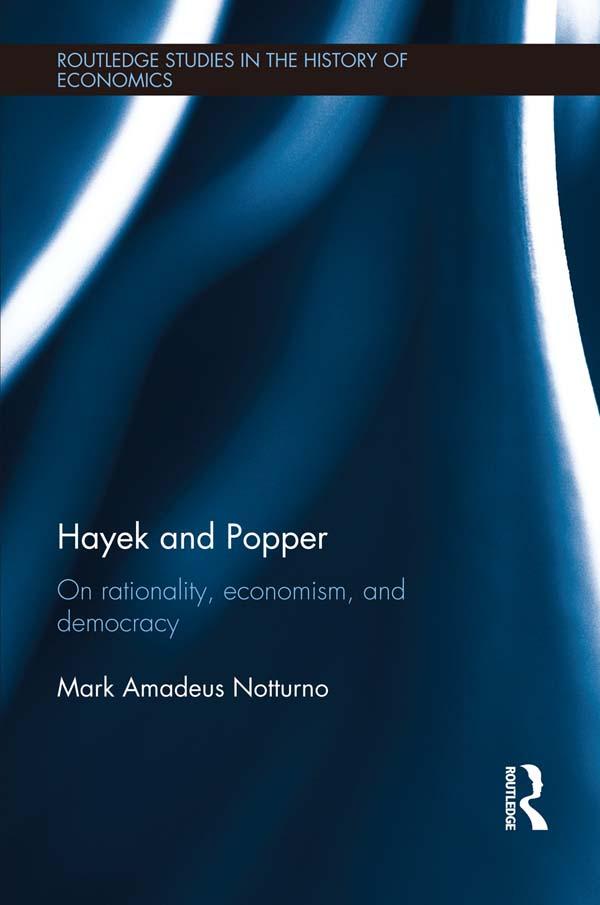
Karl Popper and Friedrich von Hayek are remembered as two of the twentieth century’s greatest proponents of open society. However, over the years, Hayek’s ideas have tended to be favoured over Popper’s in both academic and political discussions. This book aims to improve understanding of Popper’s and Hayek’s philosophies by explaining their differences, and whilst doing so, to encourage liberal political philosophers to take a better-informed and more sympathetic look at Popper’s ideas about open society.
Popper and Hayek differed in subtle but fundamental ways about rationality, economism, and democracy. They thus differed about whether and to what extent society is well served by deliberate attempts at social engineering and government intervention in the economy. They also differed about whether democracy is better served by institutions designed to elect the best leaders, or by institutions designed to protect us against the leaders we elect. And they differed, perhaps most importantly, about whether we should value freedom as a means to prosperity or an end-in-itself.
This book argues that Hayek’s views about rationality, economism, and democracy are fundamentally at odds with Popper’s¾ and perhaps even with open society itself—and that the unintended consequences of Hayek’s views may actually pose a threat to Popper’s vision of a liberal and free open society.
Betaal eenvoudig met kaart, Klarna, Apple Pay of Google Pay. Niet tevreden? Je hebt altijd 14 dagen bedenktijd. Lees meer in onze voorwaarden. Heb je vragen, mail ons dan via hello@memmo.org.
Memmo maakt studeren makkelijker – waar je ook bent ter wereld. Wij brengen je cursusboeken en slimme studietools samen op één plek: samenvattingen, quizzen, podcasts en flashcards. En Ted, je studievriend die antwoord geeft op alles wat je je afvraagt. Meer dan 50.000 studenten studeren hier al – gebouwd om je sneller te laten leren en minder stress te geven.