
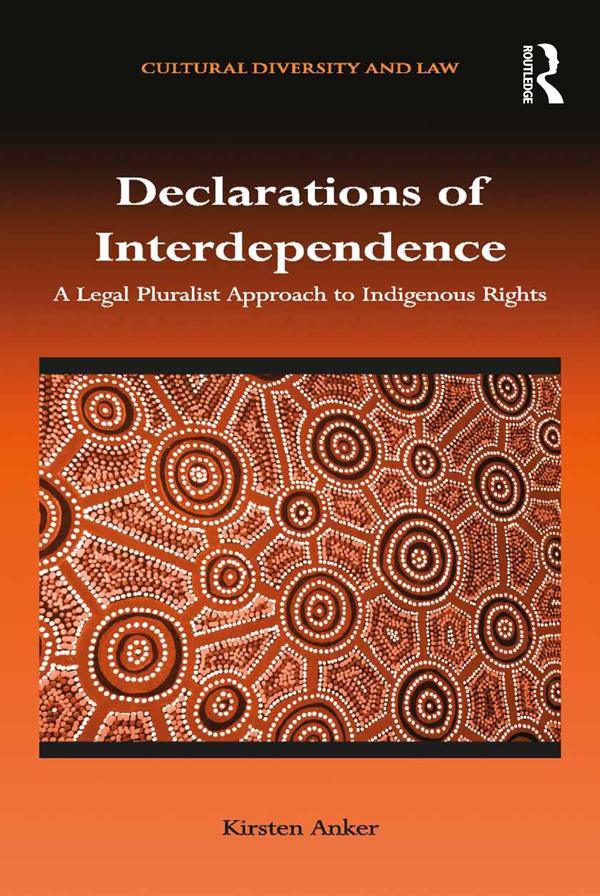
This book takes up the postcolonial challenge for law and explains how the problems of legal recognition for Indigenous peoples are tied to an orthodox theory of law. Constructing a theory of legal pluralism that is both critical of law's epistemological and ontological presuppositions, as well as discursive in engaging a dialogue between legal traditions, Anker focusses on prominent aspects of legal discourse and process such as sovereignty, proof, cultural translation and negotiation. With case studies and examples principally drawn from Australia and Canada, the book seeks to set state law in front of its own reflection in the mirror of Indigenous rights, drawing on a broad base of scholarship in addition to legal theory, from philosophy, literary studies, anthropology, social theory, Indigenous studies and art. As a contribution to legal theory, the study advances legal pluralist approaches not just by imagining a way to ’make space for’ Indigenous legal traditions, but by actually working with their insights in building theory. The book will be of value to students and researchers interested in Indigenous rights as well as those working in the areas of socio-legal studies, legal pluralism and law and cultural diversity.
Betaal eenvoudig met kaart, Klarna, Apple Pay of Google Pay. Niet tevreden? Je hebt altijd 14 dagen bedenktijd. Lees meer in onze voorwaarden. Heb je vragen, mail ons dan via hello@memmo.org.
Memmo maakt studeren makkelijker – waar je ook bent ter wereld. Wij brengen je cursusboeken en slimme studietools samen op één plek: samenvattingen, quizzen, podcasts en flashcards. En Ted, je studievriend die antwoord geeft op alles wat je je afvraagt. Meer dan 50.000 studenten studeren hier al – gebouwd om je sneller te laten leren en minder stress te geven.
Misschien vind je dit ook leuk
Koop het boek0