
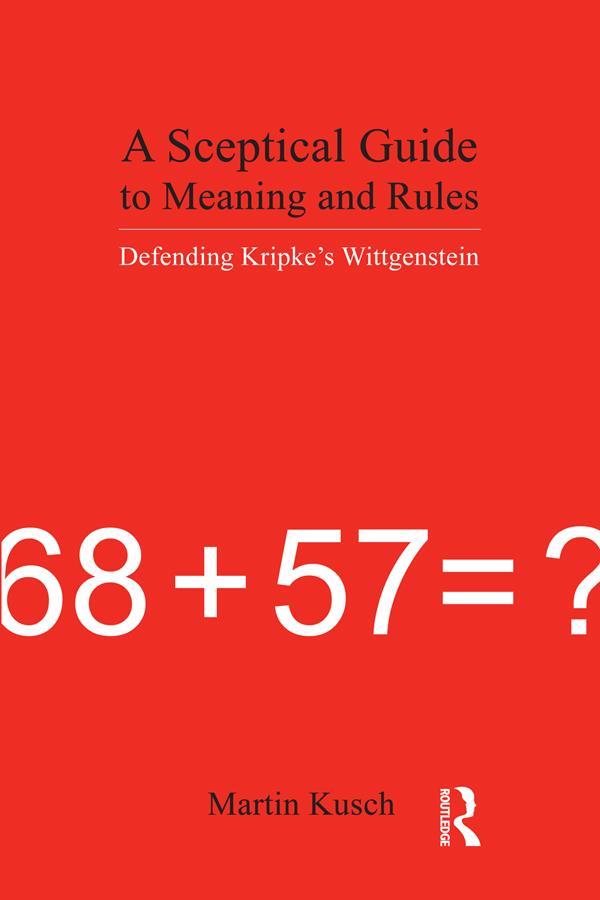
No other recent book in Anglophone philosophy has attracted as much criticism and has found so few friends as Saul Kripke's "Wittgenstein on Rules and Private Language". Amongst its critics, one finds the very top of the philosophical profession. Yet, it is rightly counted amongst the books that students of philosophy, at least in the Anglo-American world, have to read at some point in their education. Enormously influential, it has given rise to debates that strike at the very heart of contemporary philosophy of mind and language. In this major new interpretation, Martin Kusch defends Kripke's account against the numerous weighty objections that have been put forward over the past twenty years and argues that none of them is decisive. He shows that many critiques are based on misunderstandings of Kripke's reasoning; that many attacks can be blocked by refining and developing Kripke's position; and that many alternative proposals turn out either to be unworkable or to be disguised variants of the view they are meant to replace. Kusch argues that the apparent simplicity of Kripke's text is deceptive and that a fresh reading gives Kripke's overall argument a new strength.
Betaal eenvoudig met kaart, Klarna, Apple Pay of Google Pay. Niet tevreden? Je hebt altijd 14 dagen bedenktijd. Lees meer in onze voorwaarden. Heb je vragen, mail ons dan via hello@memmo.org.
Memmo maakt studeren makkelijker – waar je ook bent ter wereld. Wij brengen je cursusboeken en slimme studietools samen op één plek: samenvattingen, quizzen, podcasts en flashcards. En Ted, je studievriend die antwoord geeft op alles wat je je afvraagt. Meer dan 50.000 studenten studeren hier al – gebouwd om je sneller te laten leren en minder stress te geven.
Misschien vind je dit ook leuk
Koop het boek0