
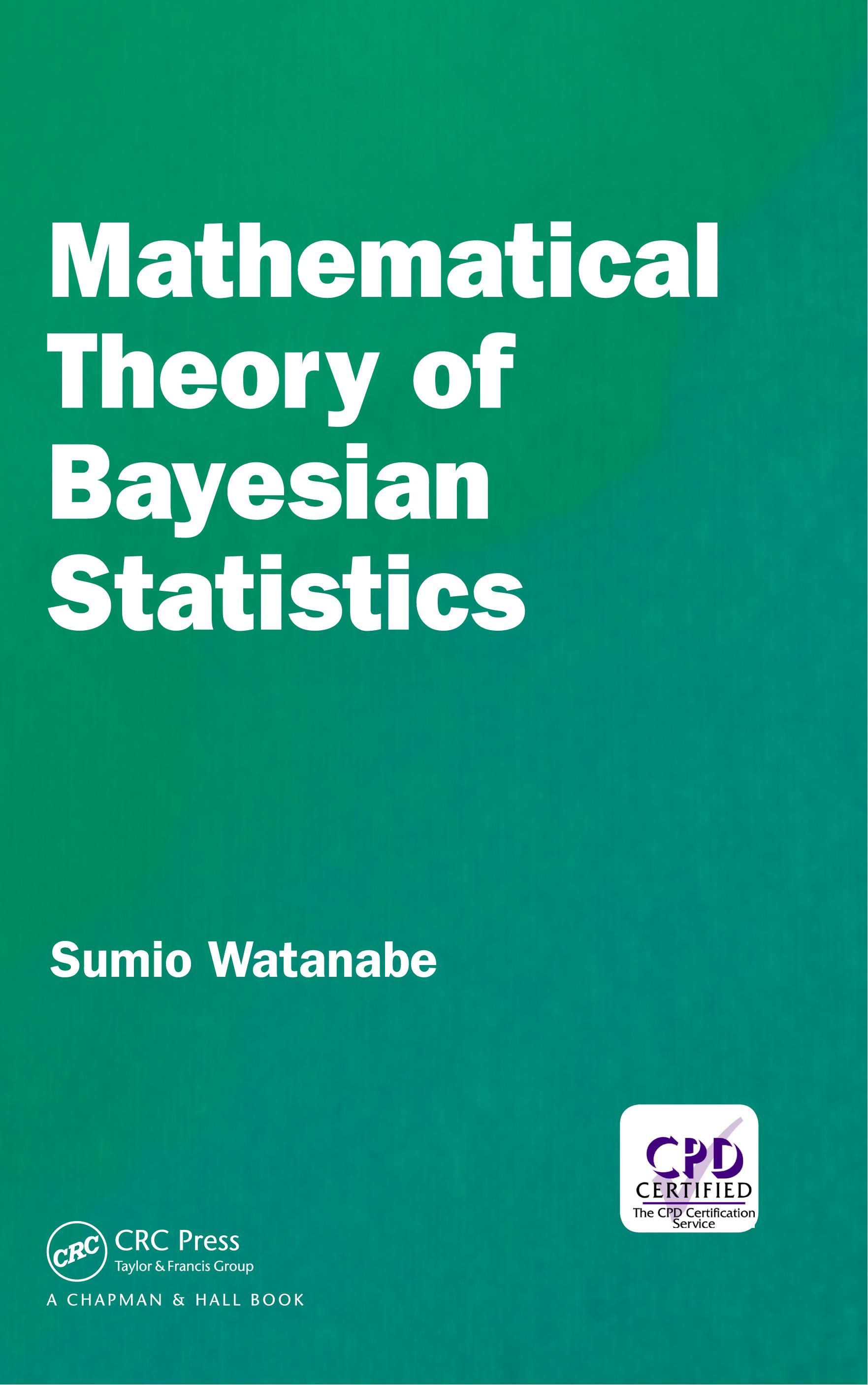
Mathematical Theory of Bayesian Statistics introduces the mathematical foundation of Bayesian inference which is well-known to be more accurate in many real-world problems than the maximum likelihood method. Recent research has uncovered several mathematical laws in Bayesian statistics, by which both the generalization loss and the marginal likelihood are estimated even if the posterior distribution cannot be approximated by any normal distribution.
Features
- Explains Bayesian inference not subjectively but objectively.
- Provides a mathematical framework for conventional Bayesian theorems.
- Introduces and proves new theorems.
- Cross validation and information criteria of Bayesian statistics are studied from the mathematical point of view.
- Illustrates applications to several statistical problems, for example, model selection, hyperparameter optimization, and hypothesis tests.
This book provides basic introductions for students, researchers, and users of Bayesian statistics, as well as applied mathematicians.
Author
Sumio Watanabe is a professor of Department of Mathematical and Computing Science at Tokyo Institute of Technology. He studies the relationship between algebraic geometry and mathematical statistics.
Betaal eenvoudig met kaart, Klarna, Apple Pay of Google Pay. Niet tevreden? Je hebt altijd 14 dagen bedenktijd. Lees meer in onze voorwaarden. Heb je vragen, mail ons dan via hello@memmo.org.
Memmo maakt studeren makkelijker – waar je ook bent ter wereld. Wij brengen je cursusboeken en slimme studietools samen op één plek: samenvattingen, quizzen, podcasts en flashcards. En Ted, je studievriend die antwoord geeft op alles wat je je afvraagt. Meer dan 50.000 studenten studeren hier al – gebouwd om je sneller te laten leren en minder stress te geven.