
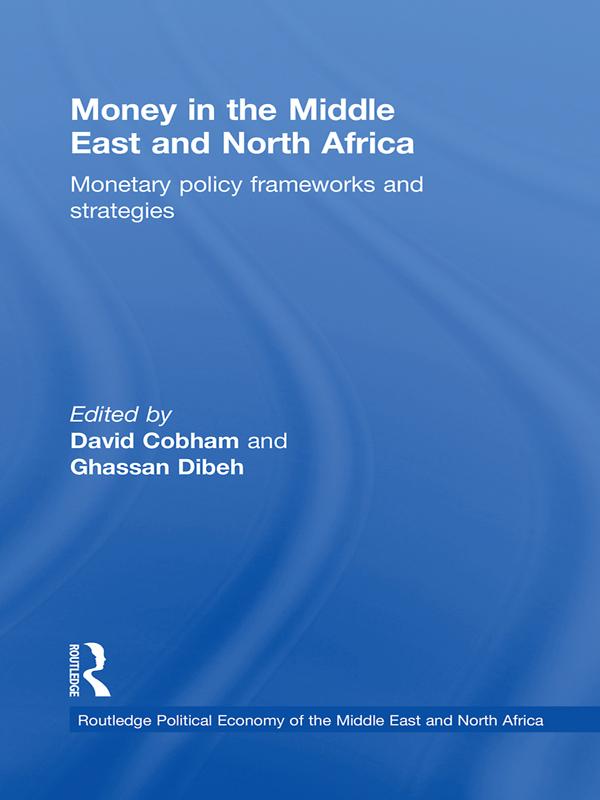
Monetary policy in the Middle East and North African (MENA) countries remains an understudied area; this book fills an important gap by examining monetary policy frameworks and monetary policy strategies in the region. Building on the editors’ earlier book, Monetary Policy and Central Banking in the Middle East and North Africa, which focused on central bank independence issues and on exchange rate regimes, this book emphasises monetary policy strategies. Part I contains an overview of the financial markets and institutions which condition the choice of monetary policy strategy in the countries of the region, followed by single-country studies on aspects of the monetary policy frameworks of Lebanon, Egypt, Jordan, the Palestinian Territory and Turkey. Part II includes analyses of the prospects for inflation targeting in Egypt, Morocco and Tunisia, of the monetary transmission mechanism in the Gulf Cooperation Council countries, of the relative advantages of inflation targeting and exchange rate fixity with reference to Egypt, of the problem of fiscal dominance in Egypt, and of the inflationary implications of exchange rate fixity for Saudi Arabia and Kuwait. The contributors are experts from universities inside and outside the MENA region, from central banks in the region and from outside institutions such as the European Central Bank and the International Monetary Fund.
Betaal eenvoudig met kaart, Klarna, Apple Pay of Google Pay. Niet tevreden? Je hebt altijd 14 dagen bedenktijd. Lees meer in onze voorwaarden. Heb je vragen, mail ons dan via hello@memmo.org.
Memmo maakt studeren makkelijker – waar je ook bent ter wereld. Wij brengen je cursusboeken en slimme studietools samen op één plek: samenvattingen, quizzen, podcasts en flashcards. En Ted, je studievriend die antwoord geeft op alles wat je je afvraagt. Meer dan 50.000 studenten studeren hier al – gebouwd om je sneller te laten leren en minder stress te geven.