
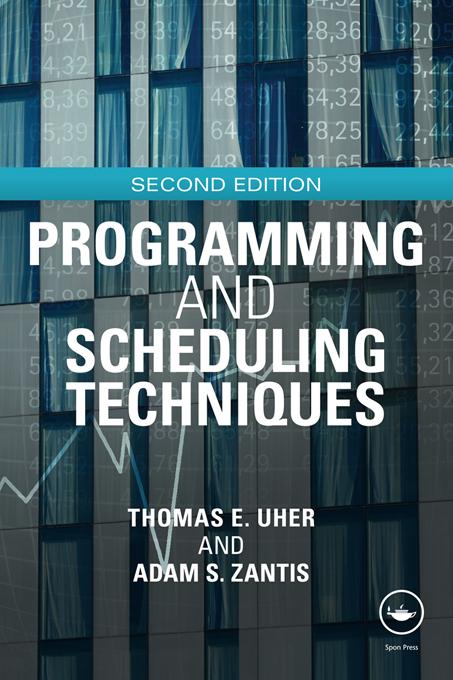
Planning is an important management function and its effective execution is crucial to ensure the success of any project. This second edition of Thomas Uher’s and Adam Zantis' textbook maintains its focus on operational rather than strategic aspects of programming and scheduling of projects, providing the reader with the practical planning skills needed to be successful.
Unlike most other textbooks that largely focus on the critical path method, Programming and Scheduling Techniques includes a comprehensive review of a range of practices used around the world. Topics covered in this thoroughly revised edition include:
- deterministic scheduling techniques including the bar chart, the critical path method, the critical chain method, the multiple activity chart and the line of balance
- a comparison of the critical path and critical chain scheduling techniques
- options for computer-based scheduling
- stochastic scheduling techniques including the critical path method based on Monte Carlo simulation and the Program Evaluation and Review Technique (PERT)
- risk in scheduling
- work study.
By covering a broad range of scheduling techniques this book is suitable for those planning projects in any industry, particularly in interdisciplinary or international contexts.
Written for students studying undergraduate and postgraduate architecture, building, construction/project management, quantity surveying, property development and civil engineering programs.
Betaal eenvoudig met kaart, Klarna, Apple Pay of Google Pay. Niet tevreden? Je hebt altijd 14 dagen bedenktijd. Lees meer in onze voorwaarden. Heb je vragen, mail ons dan via hello@memmo.org.
Memmo maakt studeren makkelijker – waar je ook bent ter wereld. Wij brengen je cursusboeken en slimme studietools samen op één plek: samenvattingen, quizzen, podcasts en flashcards. En Ted, je studievriend die antwoord geeft op alles wat je je afvraagt. Meer dan 50.000 studenten studeren hier al – gebouwd om je sneller te laten leren en minder stress te geven.