
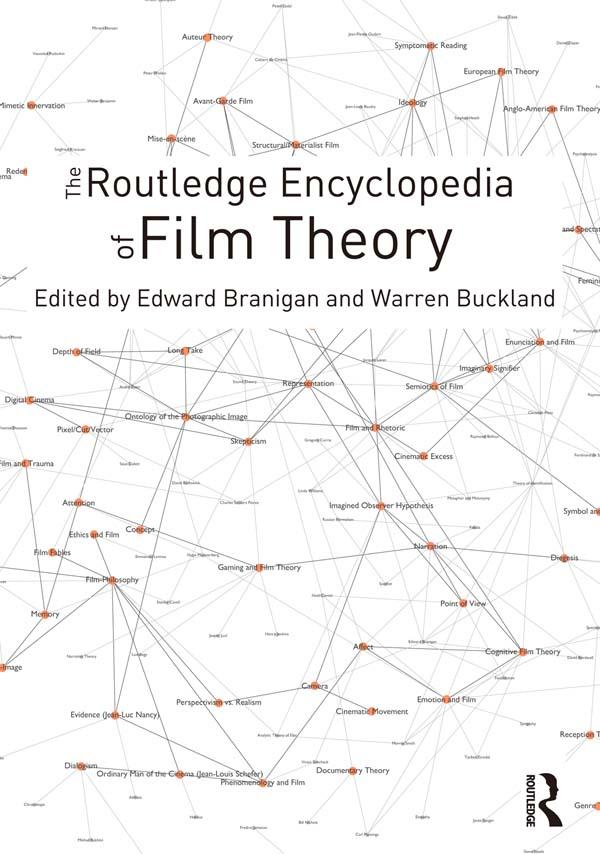
The Routledge Encyclopedia of Film Theory is an international reference work representing the essential ideas and concepts at the centre of film theory from the beginning of the twentieth century, to the beginning of the twenty-first.
When first encountering film theory, students are often confronted with a dense, interlocking set of texts full of arcane terminology, inexact formulations, sliding definitions, and abstract generalities. The Routledge Encyclopedia of Film Theory challenges these first impressions by aiming to make film theory accessible and open to new readers.
Edward Branigan and Warren Buckland have commissioned over 50 scholars from around the globe to address the difficult formulations and propositions in each theory by reducing these difficult formulations to straightforward propositions.
The result is a highly accessible volume that clearly defines, and analyzes step by step, many of the fundamental concepts in film theory, ranging from familiar concepts such as ‘Apparatus’, ‘Gaze’, ‘Genre’, and ‘Identification’, to less well-known and understood, but equally important concepts, such as Alain Badiou’s ‘Inaesthetics’, Gilles Deleuze’s ‘Time-Image’, and Jean-Luc Nancy’s ‘Evidence’.
The Routledge Encyclopedia of Film Theory is an ideal reference book for undergraduates of film studies, as well as graduate students new to the discipline.
Betaal eenvoudig met kaart, Klarna, Apple Pay of Google Pay. Niet tevreden? Je hebt altijd 14 dagen bedenktijd. Lees meer in onze voorwaarden. Heb je vragen, mail ons dan via hello@memmo.org.
Memmo maakt studeren makkelijker – waar je ook bent ter wereld. Wij brengen je cursusboeken en slimme studietools samen op één plek: samenvattingen, quizzen, podcasts en flashcards. En Ted, je studievriend die antwoord geeft op alles wat je je afvraagt. Meer dan 50.000 studenten studeren hier al – gebouwd om je sneller te laten leren en minder stress te geven.