
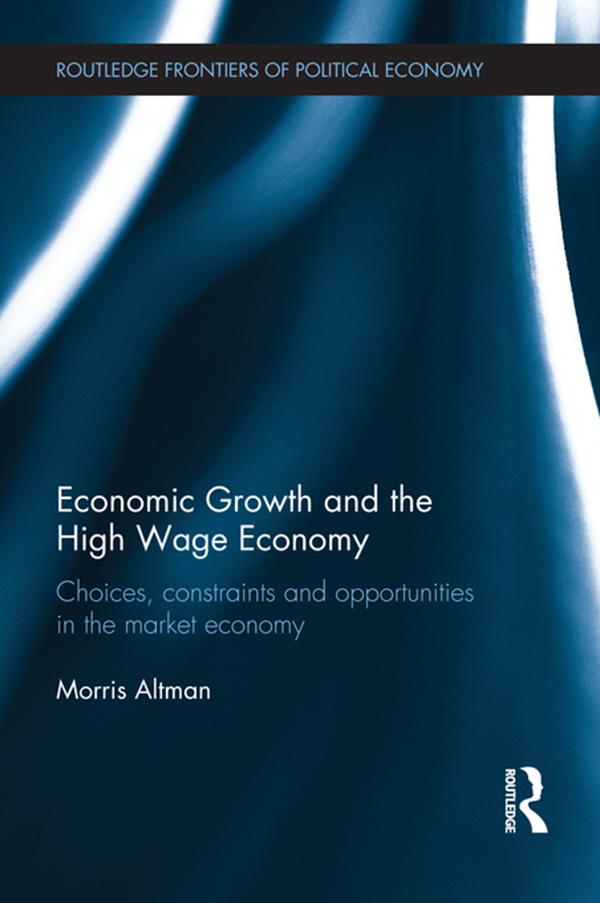
This book provides a theoretical framework to better understand how firms, economies and labor markets have evolved. This is done in a reader-friendly fashion, without complex mathematical arguments and proofs. Economic Growth and the High Wage Economy shows how high wage economies help make firms and economies more productive and why high wage economies can be competitive even in an increasingly globalized environment. It also demonstrates why concerns that labor supply will dry up as wages increase and social benefits rise are largely based on impoverished economic reasoning.
The first chapters provide a theoretical basis for the rest of the book, showing for instance how higher wages are prone to increasing the level of economic efficiency by getting people to work harder and smarter (mainly smarter). Altman also explains that our understanding of technological change can be markedly improved by modelling technological change as a product of higher wages and improved working conditions and other shocks to the economic system. As the book develops, it is shown that increasing and high levels of income inequality are not necessary for growth and development, because the economic ‘pie’ grows when the economic wellbeing of the lower half and even the middle improves. The evolution of the state can also be better understood by applying this analytical framework. So too can the persistence of inefficient systems of production and cultural traits that appear to be inconsistent with economic prosperity. On top of this, the book examines the implications of Altman’s theoretical framework for macroeconomic analysis and policy. Finally, it is shown that labor supply can be better understood by introducing target income into the analytical mix.
The main contribution of this book is providing the theoretical underpinning for why relatively high wages and, moreover, competition with high wages is good for dynamic growth and development. This work establishes why an alternative model of labor supply, based on the notion and reality of target income, does a better job of explaining the evolution of labor supply. The latter also reinforces the view that increasing wage and workers’ benefits should not be expected to damage the economy, even in the realm of labor supply. This book will be of interest to public policy experts, trade unions, human rights experts and scholars of behavioural economics, labour economics and globalization.
Betaal eenvoudig met kaart, Klarna, Apple Pay of Google Pay. Niet tevreden? Je hebt altijd 14 dagen bedenktijd. Lees meer in onze voorwaarden. Heb je vragen, mail ons dan via hello@memmo.org.
Memmo maakt studeren makkelijker – waar je ook bent ter wereld. Wij brengen je cursusboeken en slimme studietools samen op één plek: samenvattingen, quizzen, podcasts en flashcards. En Ted, je studievriend die antwoord geeft op alles wat je je afvraagt. Meer dan 50.000 studenten studeren hier al – gebouwd om je sneller te laten leren en minder stress te geven.