
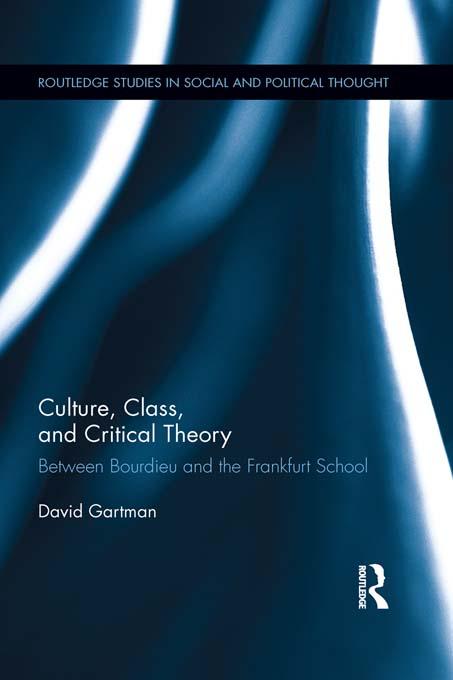
Culture, Class, and Critical Theory develops a theory of culture that explains how ideas create and legitimate class inequalities in modern society. This theory is developed through a critique and comparison of the powerful ideas on culture offered by Pierre Bourdieu and the Frankfurt School thinkers, especially Theodor Adorno. These ideas are illuminated and criticized through the development of two empirical cases on which Gartman has published extensively, automobile design and architecture.
Bourdieu and the Frankfurt School postulate opposite theories of the cultural legitimation of class inequalities. Bourdieu argues that the culture of modern society is a class culture, a ranked diversity of beliefs and tastes corresponding to different classes. The cultural beliefs and practices of the dominant class are arbitrarily defined as superior, thus legitimating its greater share of social resources. By contrast, the thinkers of the Frankfurt School conceive of modern culture as a mass culture, a leveled homogeneity in which the ideas and tastes shared by all classes disguises real class inequalities. This creates the illusion of an egalitarian democracy that prevents inequalities from being contested.
Through an empirical assessment of the theories against the cases, Gartman reveals that both are correct, but for different parts of modern culture. These parts combine to provide a strong legitimation of class inequalities.
Betaal eenvoudig met kaart, Klarna, Apple Pay of Google Pay. Niet tevreden? Je hebt altijd 14 dagen bedenktijd. Lees meer in onze voorwaarden. Heb je vragen, mail ons dan via hello@memmo.org.
Memmo maakt studeren makkelijker – waar je ook bent ter wereld. Wij brengen je cursusboeken en slimme studietools samen op één plek: samenvattingen, quizzen, podcasts en flashcards. En Ted, je studievriend die antwoord geeft op alles wat je je afvraagt. Meer dan 50.000 studenten studeren hier al – gebouwd om je sneller te laten leren en minder stress te geven.