
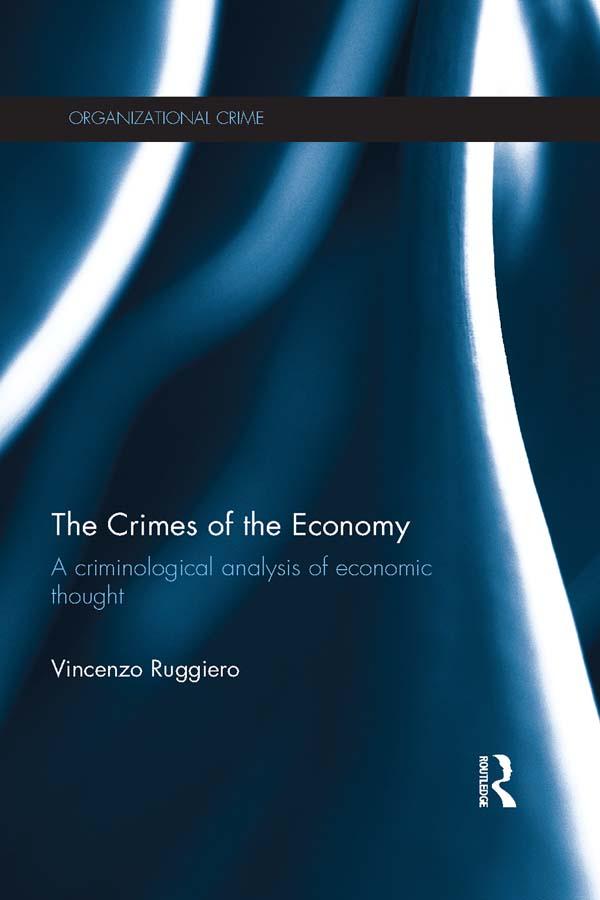
Economists have often paid visits to the field of criminology, examining the rational logic of offending. When economists examine criminal activity, they imply that offenders should be treated like any other social actor making rational choices.
In The Crimes of the Economy, Vincenzo Ruggiero turns the tables by examining a variety of economic schools of thought from a criminological perspective. Each one of these schools, he argues, justifies or even encourages harm produced by economic initiative. He investigates – among others – John Locke’s notion of private property, Mercantilism, the Physiocrats and Malthus, and the arguments of Adam Smith, Marshall, Keynes and neoliberalism. In each of these, the author identifies the potential justification of different forms of ‘crimes of the economy’ and victimisation.
This book re-examines the history of economic thought, assessing it as the history of a discipline which, while attempting to gain scientific status, in reality seeks to make the social harm caused by economics acceptable. The book will be interesting and relevant to students and scholars of social theory, criminology, economics, philosophy and politics.
Betaal eenvoudig met kaart, Klarna, Apple Pay of Google Pay. Niet tevreden? Je hebt altijd 14 dagen bedenktijd. Lees meer in onze voorwaarden. Heb je vragen, mail ons dan via hello@memmo.org.
Memmo maakt studeren makkelijker – waar je ook bent ter wereld. Wij brengen je cursusboeken en slimme studietools samen op één plek: samenvattingen, quizzen, podcasts en flashcards. En Ted, je studievriend die antwoord geeft op alles wat je je afvraagt. Meer dan 50.000 studenten studeren hier al – gebouwd om je sneller te laten leren en minder stress te geven.