
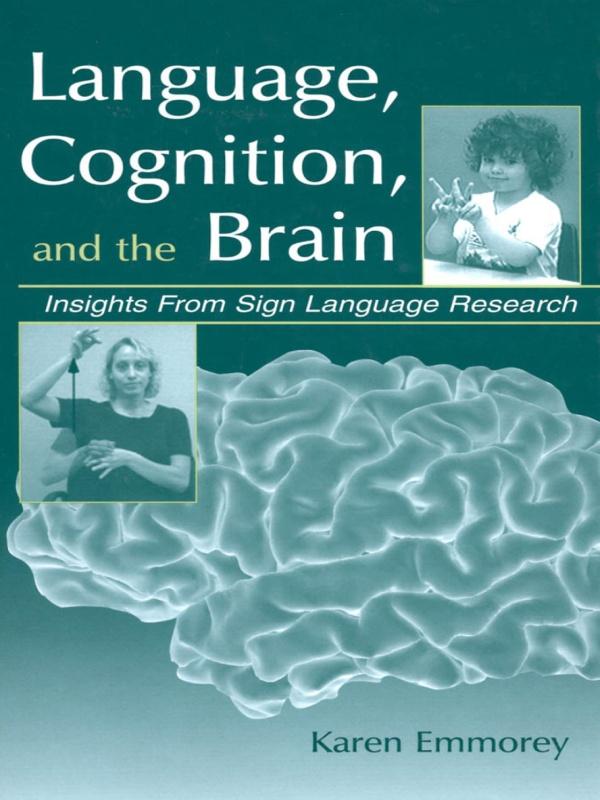
Once signed languages are recognized as natural human languages, a world of exploration opens up. Signed languages provide a powerful tool for investigating the nature of human language and language processing, the relation between cognition and language, and the neural organization of language. The value of sign languages lies in their modality. Specifically, for perception, signed languages depend upon high-level vision and motion processing systems, and for production, they require the integration of motor systems involving the hands and face. These facts raise many questions: What impact does this different biological base have for grammatical systems? For online language processing? For the acquisition of language? How does it affect nonlinguistic cognitive structures and processing? Are the same neural systems involved?
These are some of the questions that this book aims at addressing. The answers provide insight into what constrains grammatical form, language processing, linguistic working memory, and hemispheric specialization for language. The study of signed languages allows researchers to address questions about the nature of linguistic and cognitive systems that otherwise could not be easily addressed.
Betaal eenvoudig met kaart, Klarna, Apple Pay of Google Pay. Niet tevreden? Je hebt altijd 14 dagen bedenktijd. Lees meer in onze voorwaarden. Heb je vragen, mail ons dan via hello@memmo.org.
Memmo maakt studeren makkelijker – waar je ook bent ter wereld. Wij brengen je cursusboeken en slimme studietools samen op één plek: samenvattingen, quizzen, podcasts en flashcards. En Ted, je studievriend die antwoord geeft op alles wat je je afvraagt. Meer dan 50.000 studenten studeren hier al – gebouwd om je sneller te laten leren en minder stress te geven.