
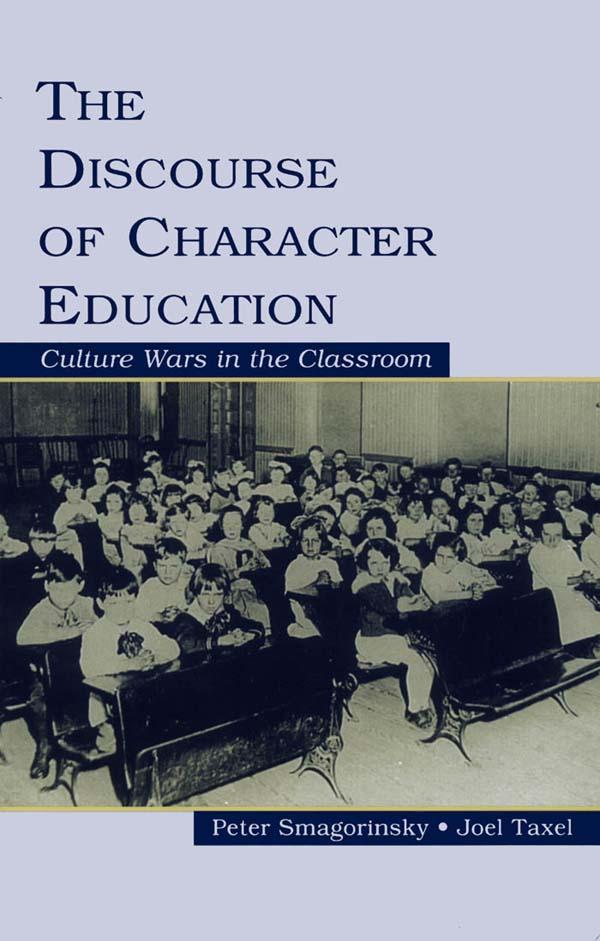
In this book Peter Smagorinsky and Joel Taxel analyze the ways in which the perennial issue of character education has been articulated in the United States, both historically and in the current character education movement that began in earnest in the 1990s.
The goal is to uncover the ideological nature of different conceptions of character education. The authors show how the current discourses are a continuation of discourse streams through which character education and the national purpose have been debated for hundreds of years, most recently in what are known as the Culture Wars--the intense, often passionate debates about morality, culture, and values carried out by politicians, religious groups, social policy foundations, and a wide range of political commentators and citizens, in which the various stakeholders have sought influence over a wide range of social and economic issues, including education.
The centerpiece is a discourse analysis of proposals funded by the United States Department of Education's Office of Educational Research and Improvement (OERI). Discourse profiles from sets of states that exhibit two distinct conceptions of character are examined and the documents from particular states are placed in dialogue with the OERI Request for Proposals. One profile reflects the dominant perspective promoted in the U.S., based on an authoritarian view in which young people are indoctrinated into the value system of presumably virtuous adults through didactic instruction. The other reflects the well-established yet currently marginal discourse emphasizing attention to the whole environment in which character is developed and enacted and in which reflection on morality, rather than didactic instruction in morality, is the primary instructional approach. By focusing on these two distinct regions and their conceptions of character, the authors situate the character education movement at the turn of the twenty-first century in the context of historical notions about the nature of character and regional conceptions regarding the nature of societal organization.
This enlightening volume is relevant to scholars, practitioners, policymakers, and students across the field of education, particularly those involved in character education, moral development, discourse analysis, history and cultural foundations of education, and related fields, and to the wider public interested in character education.
Betaal eenvoudig met kaart, Klarna, Apple Pay of Google Pay. Niet tevreden? Je hebt altijd 14 dagen bedenktijd. Lees meer in onze voorwaarden. Heb je vragen, mail ons dan via hello@memmo.org.
Memmo maakt studeren makkelijker – waar je ook bent ter wereld. Wij brengen je cursusboeken en slimme studietools samen op één plek: samenvattingen, quizzen, podcasts en flashcards. En Ted, je studievriend die antwoord geeft op alles wat je je afvraagt. Meer dan 50.000 studenten studeren hier al – gebouwd om je sneller te laten leren en minder stress te geven.