
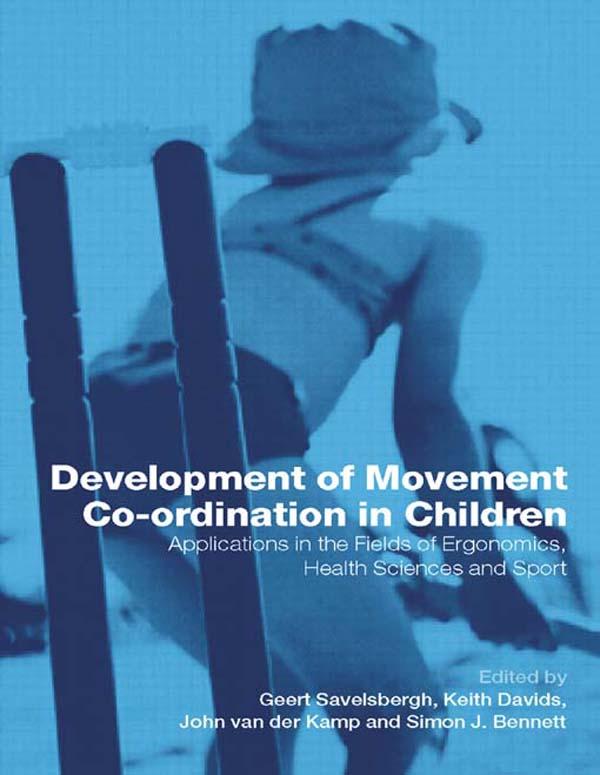
Co-ordination of movement plays a key role in human development and is an important area in sport and health sciences. This book looks in detail at how children develop basic skills, such as walking and reaching for objects, and more complex skills such as throwing and catching a ball accurately or riding a bicycle.
Development of Movement Co-ordination in Children is informed by five major theoretical perspectives and are explained in an introductory chapter:
* neural maturation
* information processing
* direct perception
* dynamic systems
* constraint theory.
The international contributions are brought together under the headings of ergonomics, health sciences and sport. Focusing on practical applications, individual chapters cover many different aspects of movement behaviour and development, ranging from children's over-estimation of their physical abilities and the links to injury proneness, to the co-ordination of kicking techniques. Both normal and abnormal development is considered.
This text will be of considerable interest to students, teachers and professionals in the fields of sport science, kinesiology, physical education, ergonomics and developmental psychology.
Betaal eenvoudig met kaart, Klarna, Apple Pay of Google Pay. Niet tevreden? Je hebt altijd 14 dagen bedenktijd. Lees meer in onze voorwaarden. Heb je vragen, mail ons dan via hello@memmo.org.
Memmo maakt studeren makkelijker – waar je ook bent ter wereld. Wij brengen je cursusboeken en slimme studietools samen op één plek: samenvattingen, quizzen, podcasts en flashcards. En Ted, je studievriend die antwoord geeft op alles wat je je afvraagt. Meer dan 50.000 studenten studeren hier al – gebouwd om je sneller te laten leren en minder stress te geven.