
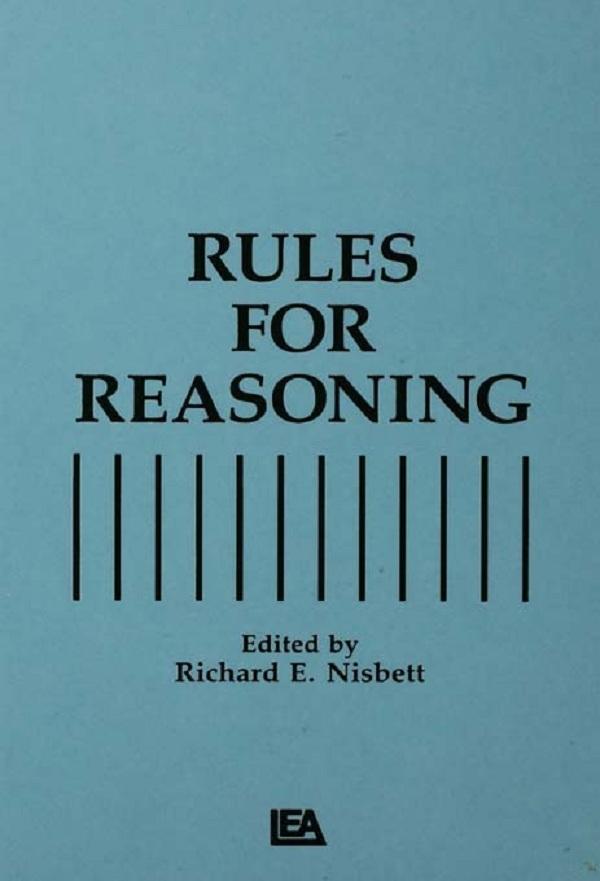
This book examines two questions: Do people make use of abstract rules such as logical and statistical rules when making inferences in everyday life? Can such abstract rules be changed by training? Contrary to the spirit of reductionist theories from behaviorism to connectionism, there is ample evidence that people do make use of abstract rules of inference -- including rules of logic, statistics, causal deduction, and cost-benefit analysis. Such rules, moreover, are easily alterable by instruction as it occurs in classrooms and in brief laboratory training sessions. The fact that purely formal training can alter them and that those taught in one content domain can "escape" to a quite different domain for which they are also highly applicable shows that the rules are highly abstract. The major implication for cognitive science is that people are capable of operating with abstract rules even for concrete, mundane tasks; therefore, any realistic model of human inferential capacity must reflect this fact. The major implication for education is that people can be far more broadly influenced by training than is generally supposed. At high levels of formality and abstraction, relatively brief training can alter the nature of problem-solving for an infinite number of content domains.
Pagina's: 432
Categorie: Psykologi
e-ISBN: 9781134775538
Verzendgewicht: 1.2 kg
Verzending binnen: 1-2 dagen
Betaal eenvoudig met kaart, Klarna, Apple Pay of Google Pay. Niet tevreden? Je hebt altijd 14 dagen bedenktijd. Lees meer in onze voorwaarden. Heb je vragen, mail ons dan via hello@memmo.org.
Memmo maakt studeren makkelijker – waar je ook bent ter wereld. Wij brengen je cursusboeken en slimme studietools samen op één plek: samenvattingen, quizzen, podcasts en flashcards. En Ted, je studievriend die antwoord geeft op alles wat je je afvraagt. Meer dan 50.000 studenten studeren hier al – gebouwd om je sneller te laten leren en minder stress te geven.
Misschien vind je dit ook leuk
Koop het boek0