
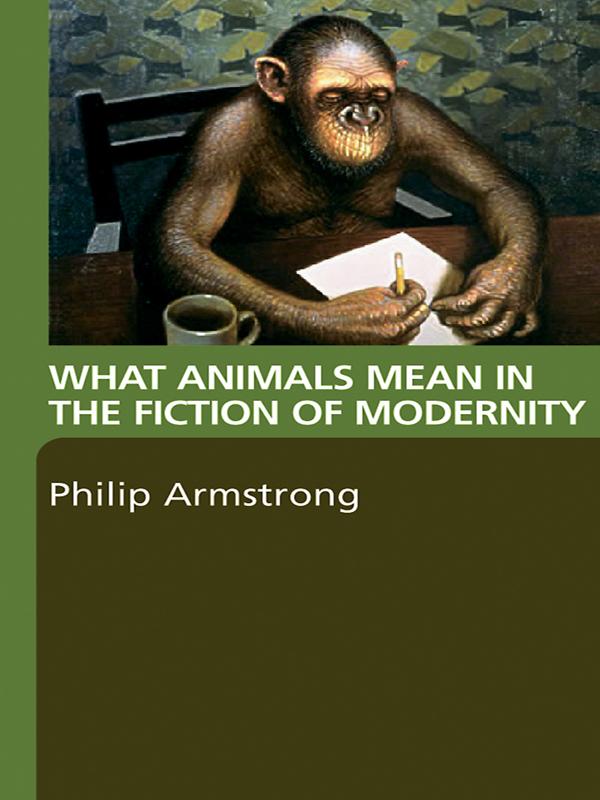
What Animals Mean in the Fiction of Modernity argues that nonhuman animals, and stories about them, have always been closely bound up with the conceptual and material work of modernity.
In the first half of the book, Philip Armstrong examines the function of animals and animal representations in four classic narratives: Robinson Crusoe, Gulliver’s Travels, Frankenstein and Moby-Dick. He then goes on to explore how these stories have been re-worked, in ways that reflect shifting social and environmental forces, by later novelists, including H.G. Wells, Upton Sinclair, D.H. Lawrence, Ernest Hemingway, Franz Kafka, Brigid Brophy, Bernard Malamud, Timothy Findley, Will Self, Margaret Atwood, Yann Martel and J.M. Coetzee.
What Animals Mean in the Fiction of Modernity also introduces readers to new developments in the study of human-animal relations. It does so by attending both to the significance of animals to humans, and to animals’ own purposes or designs; to what animals mean to us, and to what they mean to do, and how they mean to live.
Betaal eenvoudig met kaart, Klarna, Apple Pay of Google Pay. Niet tevreden? Je hebt altijd 14 dagen bedenktijd. Lees meer in onze voorwaarden. Heb je vragen, mail ons dan via hello@memmo.org.
Memmo maakt studeren makkelijker – waar je ook bent ter wereld. Wij brengen je cursusboeken en slimme studietools samen op één plek: samenvattingen, quizzen, podcasts en flashcards. En Ted, je studievriend die antwoord geeft op alles wat je je afvraagt. Meer dan 50.000 studenten studeren hier al – gebouwd om je sneller te laten leren en minder stress te geven.