
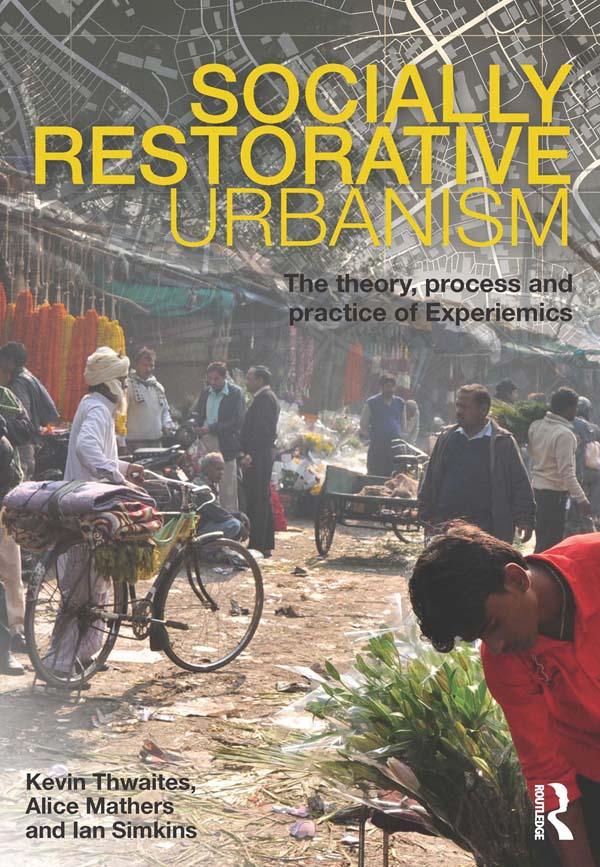
The need for a human-orientated approach to urbanism is well understood, and yet all too often this dimension remains lacking in urban design. In this book the authors argue for and develop socially restorative urbanism – a new conceptual framework laying the foundations for innovative ways of thinking about the relationship between the urban spatial structure and social processes to re-introduce a more explicit people-centred element into urban place-making and its adaptation.
Focusing on this interplay between humans and the built environment, two new concepts are developed: the transitional edge – a socio-spatial concept of the urban realm; and Experiemics – a participative process that acts to redress imbalances in territorial relationships, defined in terms of the awareness of mine, theirs, ours and yours (MTOY).
In this way, Socially Restorative Urbanism shows how professional practice and community understanding can be brought together in a mutually interdependent and practical way. Its theoretical and practical principles are applicable across a wide range of contexts concerning human benefit through urban environmental change and experience, and it will be of interest to readers in the social sciences and environmental psychology, as well as the spatial planning and design disciplines.
Betaal eenvoudig met kaart, Klarna, Apple Pay of Google Pay. Niet tevreden? Je hebt altijd 14 dagen bedenktijd. Lees meer in onze voorwaarden. Heb je vragen, mail ons dan via hello@memmo.org.
Memmo maakt studeren makkelijker – waar je ook bent ter wereld. Wij brengen je cursusboeken en slimme studietools samen op één plek: samenvattingen, quizzen, podcasts en flashcards. En Ted, je studievriend die antwoord geeft op alles wat je je afvraagt. Meer dan 50.000 studenten studeren hier al – gebouwd om je sneller te laten leren en minder stress te geven.