
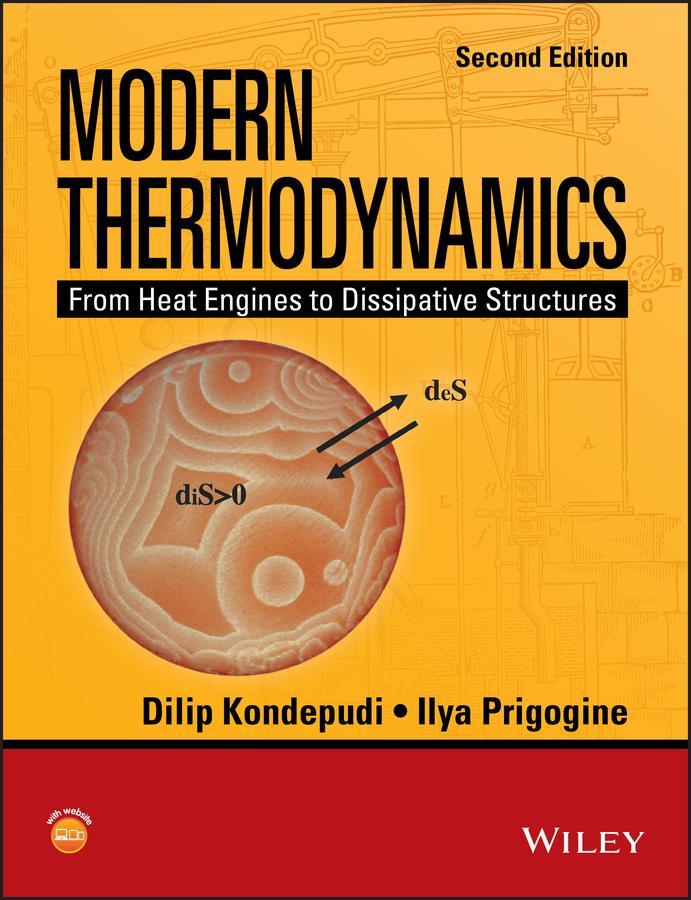
Modern Thermodynamics: From Heat Engines to Dissipative Structures, Second Edition presents a comprehensive introduction to 20th century thermodynamics that can be applied to both equilibrium and non-equilibrium systems, unifying what was traditionally divided into ‘thermodynamics’ and ‘kinetics’ into one theory of irreversible processes.
This comprehensive text, suitable for introductory as well as advanced courses on thermodynamics, has been widely used by chemists, physicists, engineers and geologists. Fully revised and expanded, this new edition includes the following updates and features:
- Includes a completely new chapter on Principles of Statistical Thermodynamics.
- Presents new material on solar and wind energy flows and energy flows of interest to engineering.
- Covers new material on self-organization in non-equilibrium systems and the thermodynamics of small systems.
- Highlights a wide range of applications relevant to students across physical sciences and engineering courses.
- Introduces students to computational methods using updated Mathematica codes.
- Includes problem sets to help the reader understand and apply the principles introduced throughout the text.
- Solutions to exercises and supplementary lecture material provided online at http://sites.google.com/site/modernthermodynamics/.
Modern Thermodynamics: From Heat Engines to Dissipative Structures, Second Edition is an essential resource for undergraduate and graduate students taking a course in thermodynamics.
Betaal eenvoudig met kaart, Klarna, Apple Pay of Google Pay. Niet tevreden? Je hebt altijd 14 dagen bedenktijd. Lees meer in onze voorwaarden. Heb je vragen, mail ons dan via hello@memmo.org.
Memmo maakt studeren makkelijker – waar je ook bent ter wereld. Wij brengen je cursusboeken en slimme studietools samen op één plek: samenvattingen, quizzen, podcasts en flashcards. En Ted, je studievriend die antwoord geeft op alles wat je je afvraagt. Meer dan 50.000 studenten studeren hier al – gebouwd om je sneller te laten leren en minder stress te geven.