
Published by the American Geophysical Union as part of the Geophysical Monograph Series, Volume 197.
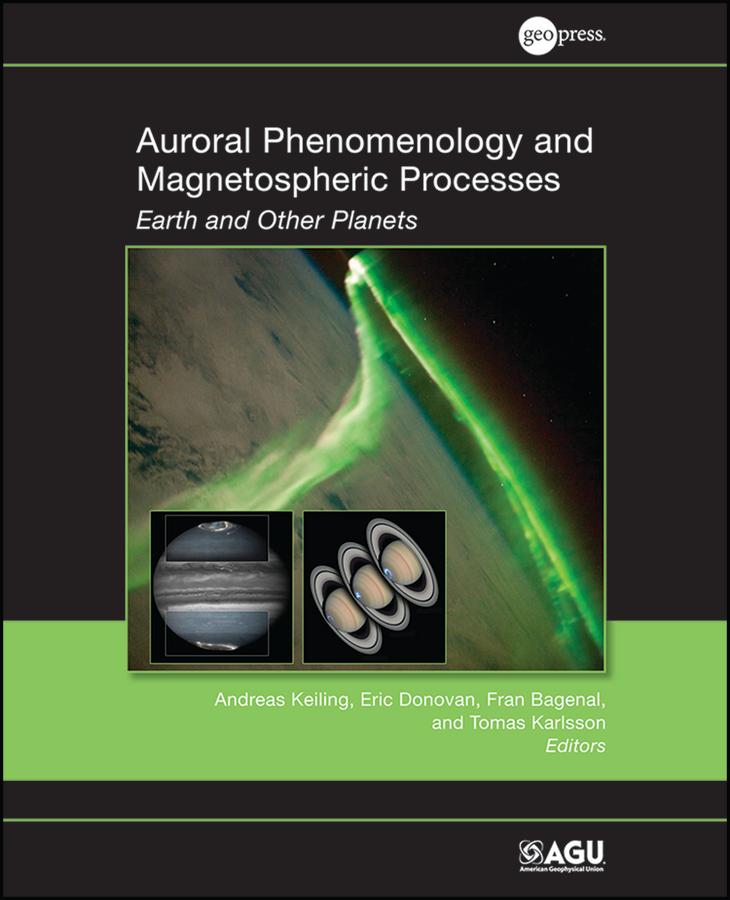
Many of the most basic aspects of the aurora remain unexplained. While in the past terrestrial and planetary auroras have been largely treated in separate books, Auroral Phenomenology and Magnetospheric Processes: Earth and Other Planets takes a holistic approach, treating the aurora as a fundamental process and discussing the phenomenology, physics, and relationship with the respective planetary magnetospheres in one volume. While there are some behaviors common in auroras of the different planets, there are also striking differences that test our basic understanding of auroral processes. The objective, upon which this monograph is focused, is to connect our knowledge of auroral morphology to the physical processes in the magnetosphere that power and structure discrete and diffuse auroras. Understanding this connection will result in a more complete explanation of the aurora and also further the goal of being able to interpret the global auroral distributions as a dynamic map of the magnetosphere. The volume synthesizes five major areas: auroral phenomenology, aurora and ionospheric electrodynamics, discrete auroral acceleration, aurora and magnetospheric dynamics, and comparative planetary aurora. Covering the recent advances in observations, simulation, and theory, this book will serve a broad community of scientists, including graduate students, studying auroras at Mars, Earth, Saturn, and Jupiter. Projected beyond our solar system, it may also be of interest for astronomers who are looking for aurora-active exoplanets.
Many of the most basic aspects of the aurora remain unexplained. While in the past terrestrial and planetary auroras have been largely treated in separate books, Auroral Phenomenology and Magnetospheric Processes: Earth and Other Planets takes a holistic approach, treating the aurora as a fundamental process and discussing the phenomenology, physics, and relationship with the respective planetary magnetospheres in one volume. While there are some behaviors common in auroras of the different planets, there are also striking differences that test our basic understanding of auroral processes. The objective, upon which this monograph is focused, is to connect our knowledge of auroral morphology to the physical processes in the magnetosphere that power and structure discrete and diffuse auroras. Understanding this connection will result in a more complete explanation of the aurora and also further the goal of being able to interpret the global auroral distributions as a dynamic map of the magnetosphere. The volume synthesizes five major areas: auroral phenomenology, aurora and ionospheric electrodynamics, discrete auroral acceleration, aurora and magnetospheric dynamics, and comparative planetary aurora. Covering the recent advances in observations, simulation, and theory, this book will serve a broad community of scientists, including graduate students, studying auroras at Mars, Earth, Saturn, and Jupiter. Projected beyond our solar system, it may also be of interest for astronomers who are looking for aurora-active exoplanets.
Betaal eenvoudig met kaart, Klarna, Apple Pay of Google Pay. Niet tevreden? Je hebt altijd 14 dagen bedenktijd. Lees meer in onze voorwaarden. Heb je vragen, mail ons dan via hello@memmo.org.
Memmo maakt studeren makkelijker – waar je ook bent ter wereld. Wij brengen je cursusboeken en slimme studietools samen op één plek: samenvattingen, quizzen, podcasts en flashcards. En Ted, je studievriend die antwoord geeft op alles wat je je afvraagt. Meer dan 50.000 studenten studeren hier al – gebouwd om je sneller te laten leren en minder stress te geven.