
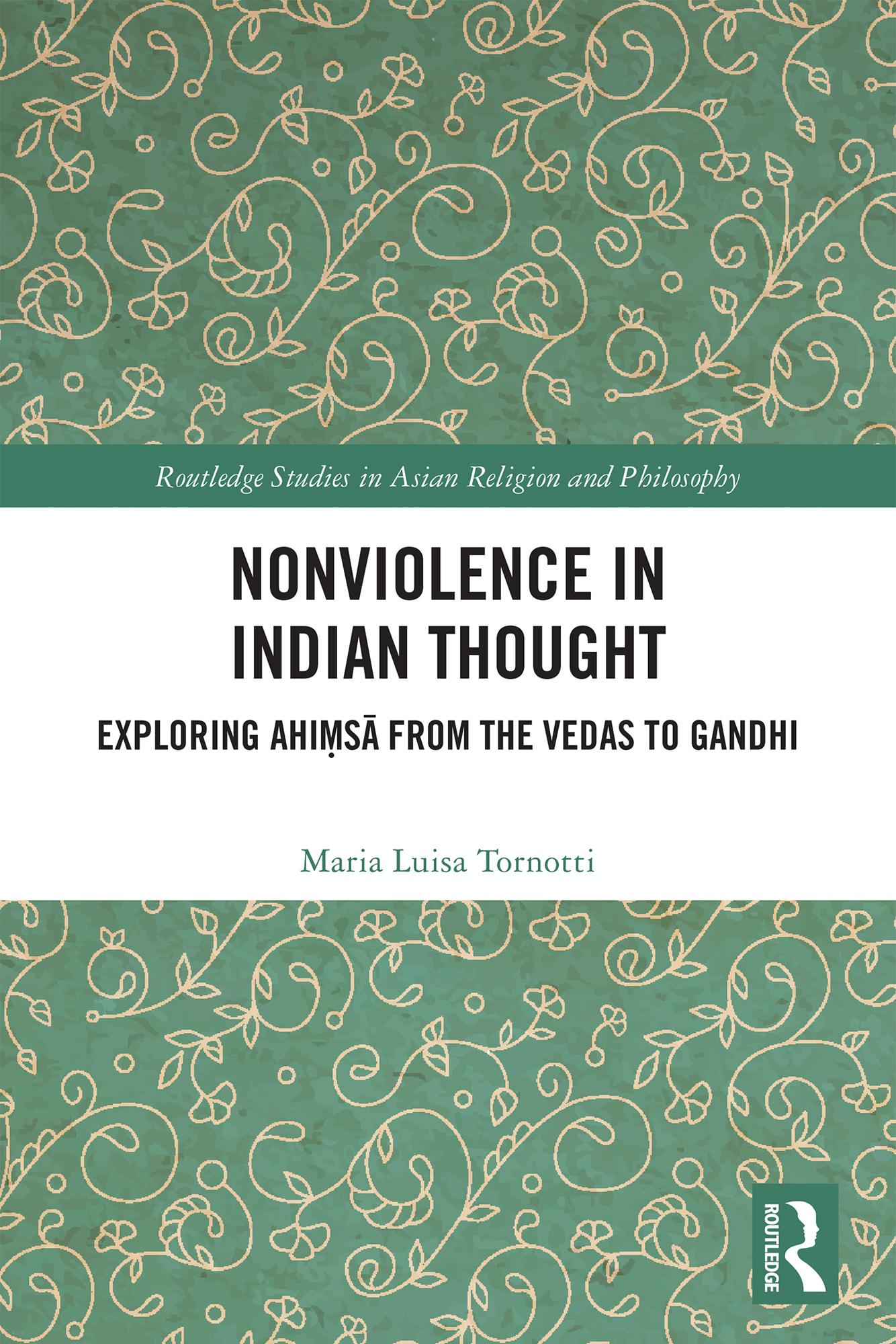
Building on the previous Italian edition, this volume presents a historical narrative and examination of the concept of ahiṃsā (nonviolence) throughout Indian religious and philosophical traditions, tracing its evolution from ancient Vedic texts to Mahatma Gandhi’s modern interpretation and application.
Acknowledging the nuances of the concept of ahiṃsā, the book makes clear that nonviolence in most of the Indic religions is located within a cluster of concepts. Taking a broadly historical and chronological approach, chapters explore the perceptions and understandings of ahiṃsā through the ancient foundational Sanskrit texts of the Vedas and Upanishads, the Hindu texts of the Dharmasutras and Mahabharata, and finally through heterodox traditional texts of Jainism and Buddhism. The book then looks at Gandhi’s comprehensive approach to ahiṃsā, demonstrating that ahiṃsā in Indian thought is not merely passive nonviolence but an active, creative principle.
Ultimately arguing that nonviolence is central to Indian spirituality, around which other ideas can be perceived as responses to this key, guiding principle, this book will be of interest to scholars, researchers and postgraduates in the fields of scriptures of Hinduism, Jainism, Buddhism, and Indian philosophy, religious studies, religion and violence, and peace studies. This book will be also useful to the general reader.
Betaal eenvoudig met kaart, Klarna, Apple Pay of Google Pay. Niet tevreden? Je hebt altijd 14 dagen bedenktijd. Lees meer in onze voorwaarden. Heb je vragen, mail ons dan via hello@memmo.org.
Memmo maakt studeren makkelijker – waar je ook bent ter wereld. Wij brengen je cursusboeken en slimme studietools samen op één plek: samenvattingen, quizzen, podcasts en flashcards. En Ted, je studievriend die antwoord geeft op alles wat je je afvraagt. Meer dan 50.000 studenten studeren hier al – gebouwd om je sneller te laten leren en minder stress te geven.