
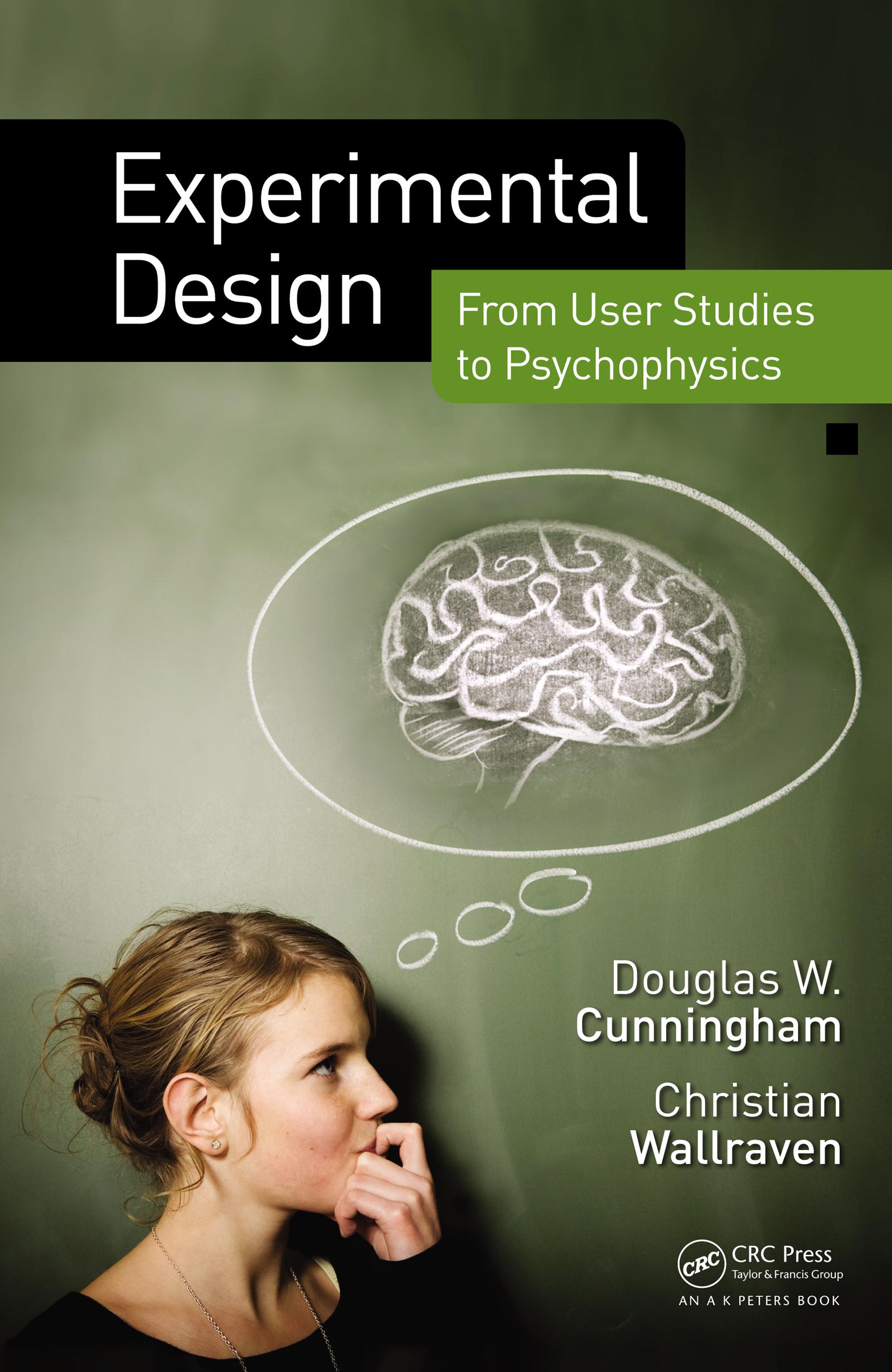
As computers proliferate and as the field of computer graphics matures, it has become increasingly important for computer scientists to understand how users perceive and interpret computer graphics. Experimental Design: From User Studies to Psychophysics is an accessible introduction to psychological experiments and experimental design, covering the major components in the design, execution, and analysis of perceptual studies.
The book begins with an introduction to the concepts central to designing and understanding experiments, including developing a research question, setting conditions and controls, and balancing specificity with generality. The book then explores in detail a number of types of experimental tasks: free description, rating scales, forced-choice, specialized multiple choice, and real-world tasks as well as physiological studies. It discusses the advantages and disadvantages of each type and provides examples of that type of experiment from the authors’ own work. The book also covers stimulus-related issues, including popular stimulus resources. It concludes with a thorough examination of statistical techniques for analyzing results, including methods specific to individual tasks.
Betaal eenvoudig met kaart, Klarna, Apple Pay of Google Pay. Niet tevreden? Je hebt altijd 14 dagen bedenktijd. Lees meer in onze voorwaarden. Heb je vragen, mail ons dan via hello@memmo.org.
Memmo maakt studeren makkelijker – waar je ook bent ter wereld. Wij brengen je cursusboeken en slimme studietools samen op één plek: samenvattingen, quizzen, podcasts en flashcards. En Ted, je studievriend die antwoord geeft op alles wat je je afvraagt. Meer dan 50.000 studenten studeren hier al – gebouwd om je sneller te laten leren en minder stress te geven.