
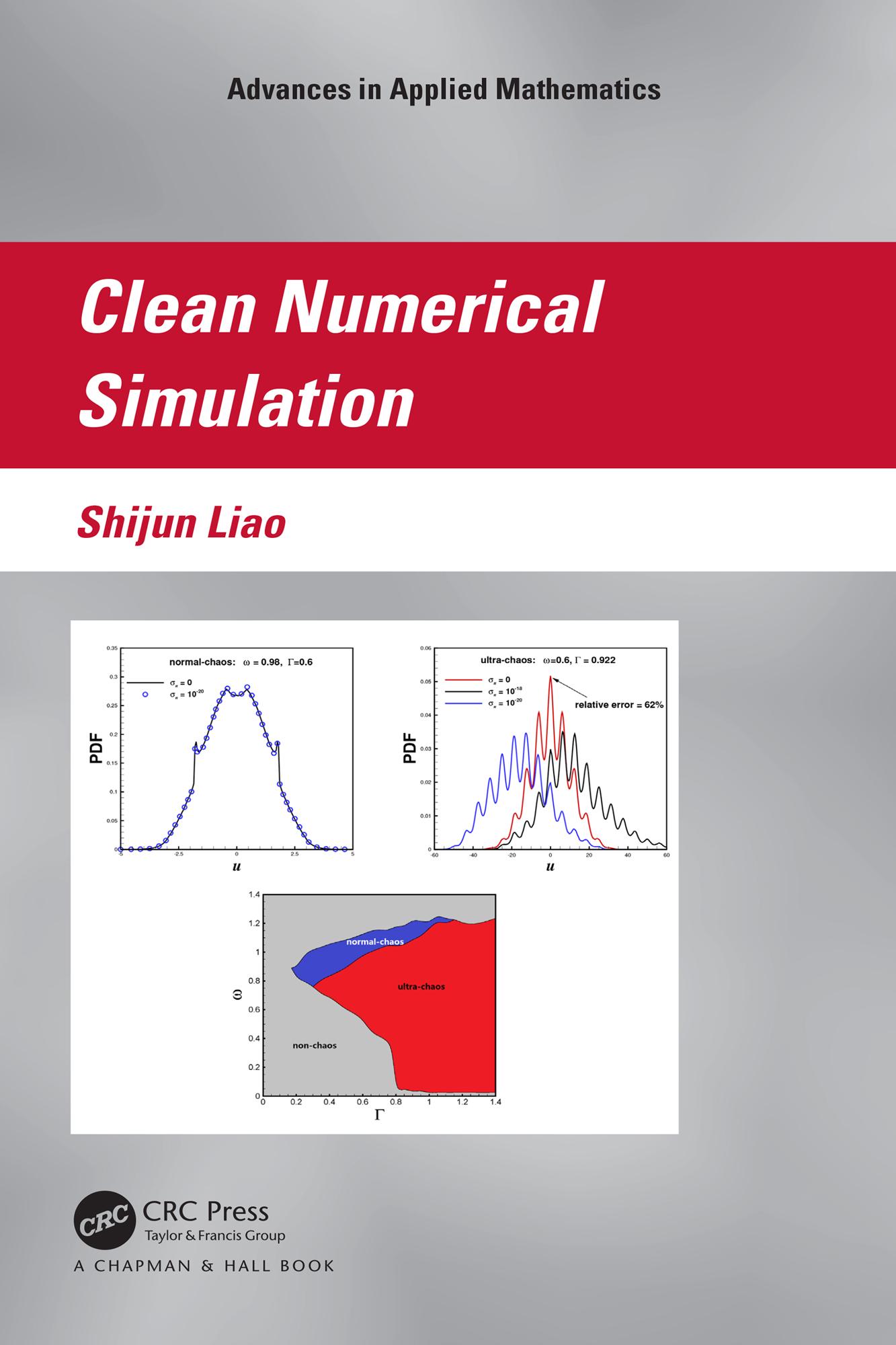
This book describes the basic principles of Clean Numerical Simulation (CNS) proposed by the author in 2009, as well as several of its applications. Unlike conventional algorithms, CNS gives in a sufficiently long interval of time a convergent chaotic trajectory whose numerical noise is much lower than the true physical solution, so that one can gain accurately. Thus, CNS provides for the first time an ability to check statistics stability of chaos, leading to a completely new concept of "ultra-chaos," which has both trajectory instability and statistics instability, and thus is of a higher disorder.
Notably, it is impossible to repeat experimental results of ultra-chaos even in the statistical sense. However, the reproducibility of physical experiments forms a cornerstone for modern science. Thus, ultra-chaos reveals an incompleteness of the modern science paradigm. In addition, it also reveals statistics stability as a precondition for use of conventional algorithms, including direct numerical simulation (DNS). In Clean Numerical Simulation, several conjectures and open problems are proposed, including a modified fourth Clay millennium problem.
Indeed, CNS opens the door for us to enter the "clean" numerical world of chaos and turbulence.
Betaal eenvoudig met kaart, Klarna, Apple Pay of Google Pay. Niet tevreden? Je hebt altijd 14 dagen bedenktijd. Lees meer in onze voorwaarden. Heb je vragen, mail ons dan via hello@memmo.org.
Memmo maakt studeren makkelijker – waar je ook bent ter wereld. Wij brengen je cursusboeken en slimme studietools samen op één plek: samenvattingen, quizzen, podcasts en flashcards. En Ted, je studievriend die antwoord geeft op alles wat je je afvraagt. Meer dan 50.000 studenten studeren hier al – gebouwd om je sneller te laten leren en minder stress te geven.