
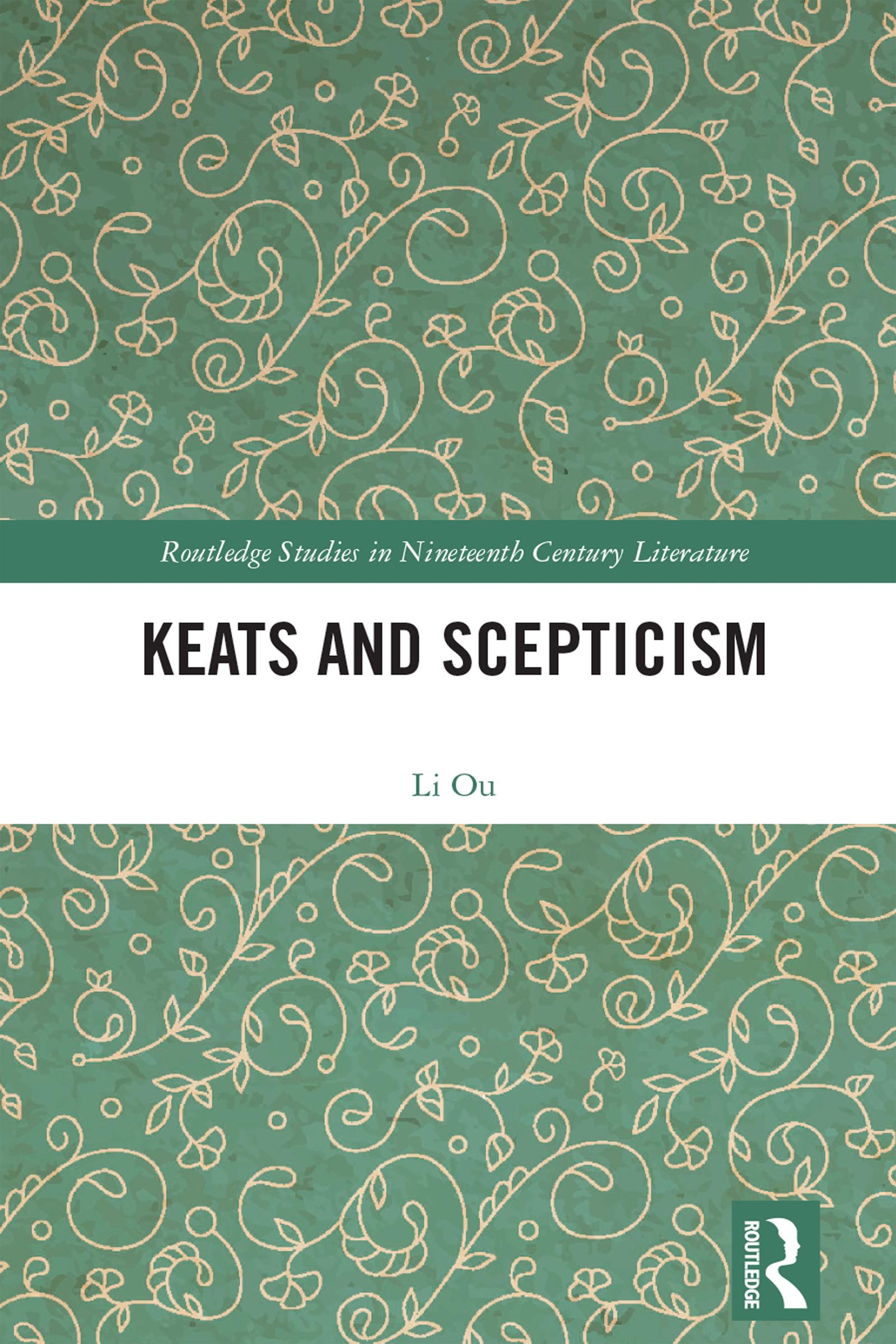
Keats and Scepticism explores Keats’s affinity with the philosophical tradition of scepticism and reads Keats’s poetry anew in the light of this affinity. It suggests Keats’s links with the origin of scepticism in ancient Greece as recorded in Sextus Empiricus’s Outlines of Scepticism. It also discusses Keats’s connections with Montaigne, the most important Renaissance inheritor of Pyrrhonian scepticism; Voltaire, the Enlightenment philosophe whose sceptical ideas made an indelible impact on Keats; and Hume, the most thoroughgoing sceptic after antiquity. Other than Keats’s affinitive ideas with these sceptical thinkers, this book is particularly interested in Keats’s experiments with the peculiar language, forms, modes, and genres of poetry to convey the non-dogmatic philosophy. In this light, it re-reads Isabella, ‘La Belle Dame sans Merci’, the 1819 odes, the two Hyperions, King Stephen, and Lamia, all of which reveal Keats’s self-reflexive and radical sceptical poetics in challenging poetic dogmas and conventions.
This book is for Keats lovers, students, teachers, scholars, or non-academic readers who are interested in Romanticism, nineteenth-century studies, or poetry and philosophy in general. This original, accessible interdisciplinary study aims to offer the reader a fresh perspective to read Keats and appreciate the quintessential Keatsian poetics.
Betaal eenvoudig met kaart, Klarna, Apple Pay of Google Pay. Niet tevreden? Je hebt altijd 14 dagen bedenktijd. Lees meer in onze voorwaarden. Heb je vragen, mail ons dan via hello@memmo.org.
Memmo maakt studeren makkelijker – waar je ook bent ter wereld. Wij brengen je cursusboeken en slimme studietools samen op één plek: samenvattingen, quizzen, podcasts en flashcards. En Ted, je studievriend die antwoord geeft op alles wat je je afvraagt. Meer dan 50.000 studenten studeren hier al – gebouwd om je sneller te laten leren en minder stress te geven.