
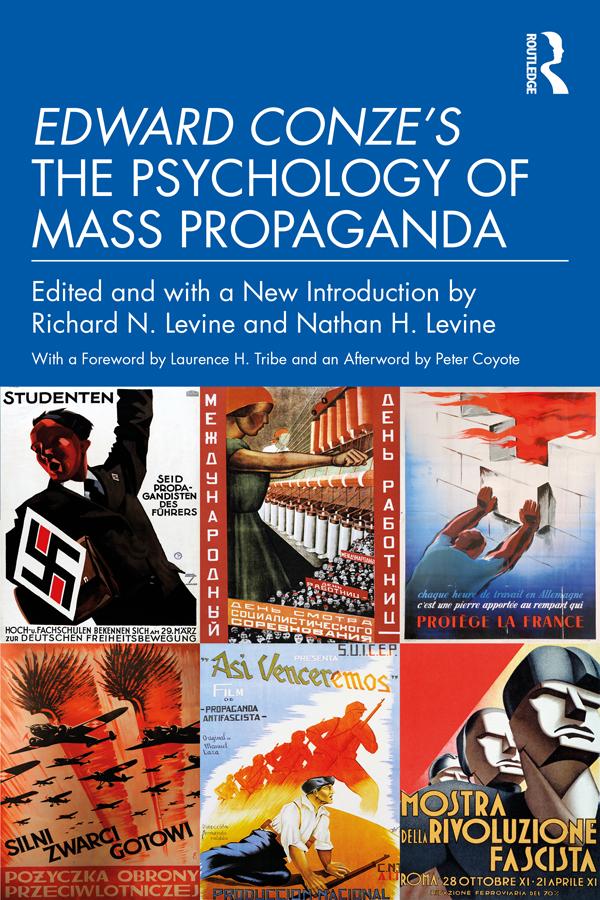
Edward Conze’s The Psychology of Mass Propaganda presents a commentary on the psychology of propaganda during the rise of fascism in Europe in the 1930s. It discusses the conditions which generate vulnerability to misinformation in human societies, and thus offers insight into how propaganda may be "withstood." Completed in 1939, during the period of Conze’s own inflection from Marxist philosophy to Buddhist studies, the original manuscript was never published and is now in print for the first time.
Presenting a unique historical perspective, while also appealing to an acutely topical interest in the conditions under which autocracy and fascism arise, the book examines the psychology of mass propaganda through copious contemporary and historical examples. Conze focuses especially on recent news articles and the statements of the propagandists of many of the governments that would go on to participate in the Second World War, including Germany, Italy, the USSR, USA and UK, all of which he interprets through the lens of recent psychological and historical research. The book has been edited and includes a new introduction by Richard N. Levine and Nathan H. Levine, also featuring a foreword by American legal scholar Laurence H. Tribe, and an afterword by actor, director, writer, and Buddhist priest Peter Coyote.
This is a fascinating opportunity for scholars across several disciplines, including political scientists and psychologists, historians and sociologists, to access one of Conze’s previously unpublished works. It will also be of importance to those interested in Conze’s work on Buddhist philosophy, and in the psychology of propaganda more broadly.
Betaal eenvoudig met kaart, Klarna, Apple Pay of Google Pay. Niet tevreden? Je hebt altijd 14 dagen bedenktijd. Lees meer in onze voorwaarden. Heb je vragen, mail ons dan via hello@memmo.org.
Memmo maakt studeren makkelijker – waar je ook bent ter wereld. Wij brengen je cursusboeken en slimme studietools samen op één plek: samenvattingen, quizzen, podcasts en flashcards. En Ted, je studievriend die antwoord geeft op alles wat je je afvraagt. Meer dan 50.000 studenten studeren hier al – gebouwd om je sneller te laten leren en minder stress te geven.